I wrote a review for the Leicester University site, Everybody’s Reviewing run by the novelist, short story writer, poet, and all round good person, Jonathan Taylor (whose partner is the poet Maria Taylor, who previously appeared on PP).
Jonathan has just published a really interesting short story collection, with the wonderful title, ‘Scablands, and other stories’. Published by Salt. You can grab a copy here.
William Letford’s new poetry/prose book, forthcoming in August with Carcanet. You can get a copy of it here.
Review of ‘From Our Own Fire’, by William Letford
As a planet, we may or may not be near an apocalyptic ending. But the notion of such an event, whether triggered by contagion, nuclear war, robotic takeover, or ecological disaster, has never been more in the forefront of our minds. Art has reacted, as it should, through books like The Road, and TV series such as Black Mirror and Sweet Tooth.
Letford’s latest book ‘From Our Own Fire’ (his first in seven years), is a speculative poetic response to this contemporary terror, one that takes a very different path both in form and subject from his previous work.
The global economy is gone
Good. It was just
murmurations in the sky
Opulent and undecipherable
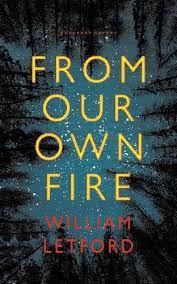
The book is written as the journal of a stonemason and his working class family, the Macallums. Hybrid in form, a page of prose is followed by a linked poem throughout.
We are embedded in the family’s survivalist response to what appears an hyper-capitalist gear change by the ruling elites. A rogue robot, The Intelligence, nicknamed Andy by the family, is on the loose, casting chaotic AI on an already chaotic situation.
‘During the days Andy worked on the messages, the Baked Bean hoarders were out in force. Supermarket shelves emptied and people stepped out of their front doors like meerkats. In the middle of the madness, Joomack invited me to a tattoo party.’
In Letford’s first two Carcanet collections (Bevel in 2012, then Dirt in 2016), his ambit was the lives of the working class. The loiterers, barflies, manual workers, from the place he came from, and those of his travels. Giving voice to the working class, often with the lyricism of the Scottish dialect.
‘From Our Own Fire’, has a similar cast list, but is a much more inventive and frightening book for all that it foreshadows. It could have been overdramatic, but in Letford’s hands it is done with poignancy, humour, and beauty.
 Proletarian Poetry