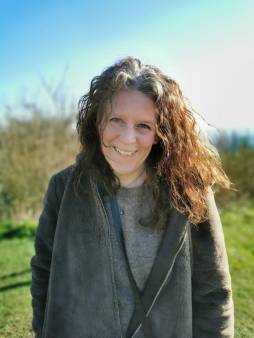
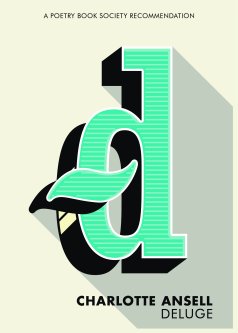
Today we have Charlotte Ansell with a poem from her third collection ‘Deluge‘ published by the wonderful press ‘Flipped Eye‘ (which has published the first work of many now well-known poets such as Warsan Shire, Malika Booker, Inua Ellams). I really relate to this post as I haven’t been able to write much at all during this time. A fellow member of Malika’s Poetry Kitchen, you can buy ‘Deluge’ here. So over to Charlotte:
*********************************
 “It seems to me, that this global pandemic leaves me unable to write a thing except maybe clichés; tired phrases. I can’t write about it but writing about anything else seems unthinkable. I’m aware that for some poets I know, the opposite is true and poems are pouring out of them. One way or another we are all affected and not just in regards writing; some people find themselves unable to do anything productive whilst others throw themselves into activity – we find our own ways of dealing with the anxiety. There is a definition of trauma that makes a correlation between the perceived level of threat and the perceived level of helplessness we feel in response to it; essentially when an event overwhelms our ability to cope. The reverberations of this collective trauma will be around long after the lockdown ends.
For me, unable to go on a planned family holiday this Easter, I have spent the last two weeks immersed in renovating and decorating the boat we live on which was badly in need of attention inside. I find painting soothing and therapeutic – the physical activity lends itself to mindlessness and a break from the over exertion of my brain when I am at work.
This decorating stint has put me in mind of a time a few years ago when I was painting a shipping container we used as a shed on our old mooring on a canal in Yorkshire. That was a time when the world was in the midst of another global disaster albeit one that affected only a small group of people directly but left its mark on our collective psyche. Back then it seemed every newspaper and every TV news bulletin brought images of bodies washed up on beaches; those of refugees making impossible journeys by boat and why? Because as Warsan Shire put it so deftly in her poem ‘Home’:
You have to understand,
no one puts their children in a boat
unless the water is safer than the land.
 I remember the helplessness I felt then too and how painting led me to writing this poem, ‘Drowning’. I wanted to send something cheerful and uplifting for this guest post but of the few more cheerful poems I’ve written nothing seemed right. I read a Facebook post a friend shared recently by someone who said the last time they were in lockdown was during the Bosnian War, which was a whole different story to the lockdown most of us are enduring now. We have food, all the usual amenities, even Netflix and there is something in these comforts whilst the privation, is in not being able to see loved ones, not being able to meet up and hug and come together. This lockdown is trying mentally, and terribly so for some; especially those living alone or those for whom home contains the risk of domestic abuse. I don’t want to underestimate the impact of that but for most of us there is not the loss of the very basic necessities or the desperate impetus to flee from the unimaginable horrors that make home no longer a safe place. So here is my poem about our most fundamental need for a home- and here’s hoping that the next time I embark on a DIY project the world will not be in the grip of another catastrophe.”
Charlotte Ansell‘s third poetry collection ‘Deluge‘ was published by Flipped Eye in November 2019 and was a PBS winter recommendation. She performs her poems regularly and her work has appeared in Poetry Review, Mslexia, Butcher’s Dog, Prole, Algebra of Owls and various anthologies; most recently ‘These are the hands’ – an anthology of poems by NHS workers. She has won various competitions (Red Shed, BBC Write Science competition in 2015, Watermarks in 2016, commended in Yorkmix in 2016 and shortlisted in the Poetry in film category of the Outspoken prize for poetry in 2017). Charlotte is the recipient of a Royal Society of Literature Award 2020 with fellow poet Janett Plummer for a forthcoming project enabling adopted young people to explore their experience via creative writing workshops. She is a member of Malika’s Poetry Kitchen collective.
Drowning
When the news breaks and the tide cannot be turned
I find comfort in the Muslim call to prayer on TV,
its mathematical calm laps over me
like today as I paint, ripples of chatter
from the Eastern European family fishing
on the opposite bank of the canal.
I relax into the peace of incomprehensible words
the laughter of children – still the same –
the cheers when they catch a fish.
I wouldn’t eat anything from this water
maybe they wouldn’t either,
I push my assumptions down, drown them in paint.
We co-exist in this subdued day
Cloud muffling out any extremes
the odd phrase in English reaches me
and when they leave, a man calls out:
Beautiful painting- you come paint my house?
See you next time!
Not everything can be covered, made new.
When my friend’s appeal for asylum was refused
I went around; the nakedness of the packing boxes,
the panic in her daughters’ eyes
and her without her hijab.
Somehow, I couldn’t hug her
seeing her so exposed.
Three years later they let her stay.
Isn’t that all anyone wants,
a safe place to call home?
I go back to painting,
the grey green expanse grows,
soothing my eyes. If only
it didn’t remind me of the cold sea,
the slip slop of the brush like the slap of waves
lifting a dress to expose a nappy
breaking over pliable limbs,
on her head a swirl of dark curls
frames her little face,
as if in repose.
 The other week, I was helping out
  Like Father, like son. Well, when your father is Donald Trump, those footsteps should not be ones that you follow. But when nurture combines with nature, Junior treads where he has been fomented. DT Junior,
 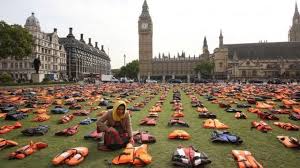 Those who came from another land, whether back in the day, or last week, are the currency of conversation and policy debate and inaction, at the present time. They are used in debates about Brexit, the war in Syria, lone terror attacks in the US, co-ordinated ones in Paris and Brussels. They are said to be the reason for Angela Merkel’s weak results in last week’s election in Germany,
  Matt Duggan’s poem “Voices from the Charcoal”, captures these fluid, turbulent and fateful times; “fishing boats once floating saviours for the persecuted/now we build walls from those we’ve liberated; /Cutting off our own ears /awakening a poisonous serpent for oil.” The powerful extract economically from other countries, through war for oil, then leave a mess that goes beyond the borders they originally set post-WW1. Matt reflects this marrying of history, “Those dusting jackboots are stomping/on the gravestones of our ancestors,/though we’d fill a whole lake with blood oil /we’d starve our own children leaving them to die on its banks.”
  Well the European Union is to lose a member. Maybe it will lose other members. Maybe it will be the end of the Union. What it won’t make a difference to (at least in positive terms), are the crises from Libya to Afghanistan that see thousands of refugees attempting to come to European shores. I am not going to get into the reasons for this fracture in European politics, which is as worrying at it has been since WW2. But one reason is not immigration. I don’t mean people didn’t vote with immigration as an issue, what I mean is that, whether there is an EU or not, it won’t make the slightest difference to these war torn people. And that is the shame of the referendum, which in my opinion should not have been undertaken. It was an ego trip of Cameron to have a legacy; well he’s got one now, but like Blair, it’s not the one he wanted.
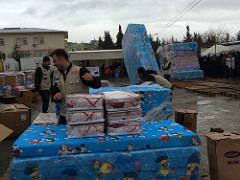
 The other sad irony of the decision to Leave is that the United Kingdom couldn’t be further away (in European terms) from the influx of large numbers of refugees. Added to this tragedy has been the fact that this has been left to the most crisis ridden country in Europe, Greece, to deal with it. Emer Davis shows us first-hand the situation facing Greece during this time in her poignant poem, Transient Lives. (Emer was selected as an asylum expert to assist the European Asylum Support Office (EASO) with the EU Relocation Programme on Lesvos Island). “Lesbos/Home to ouzo/And olive oil,/Cobbled lanes and wooden balconies,/The rambling stillness/Of the petrified forest,/Burnt skin trembling/Among dead trees,/We tremble in the evening sun/Re-telling the stories we heard,/And watch an old fisherman Bashing an octopus against a wall.”

 Proletarian Poetry