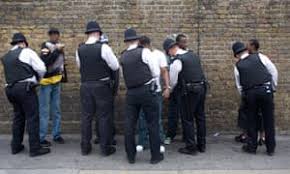
 One Sunday afternoon in 1980, on our way from Coventry to see Black Uhuru in Brighton, the Bedford police stopped us on the M1 due to the fact that clouds of collie weed filled the inside of the motor. I have only been ‘put’ in a police cell on this one occasion. I was locked up for four hours, with two mates who had done a bit of time so thought this was a stroll in the park. They decided to wind me up by shouting at the beasts, ‘you’ll never take us alive copper!’ as they kicked the mattresses and banged the door, before falling onto the floor in a heap of laughter. (more…)
Author: Peter Raynard
If We Were Real Quiz – the answers
 So, here are the answers (poem below). Hope you did well.
ANSWERS
- TASTE OF HONEY
- LONELINESS OF THE LONG DISTANCE RUNNER
- SATURDAY NIGHT SUNDAY MORNING
- A KIND OF LOVING
- FOOTBALL FACTORY
- NIL BY MOUTH
- THIS IS ENGLAND
- CONFESSIONS OF A WINDOW CLEANER
- RITA, SUE & BOB TOO
- EDUCATING RITA
- SHIRLEY VALENTINE
- BILLY ELLIOTT
- TRAINSPOTTING
- TOP BOY
- SHAMELESS
- LOCK, STOCK & TWO SMOKING BARRELS
If We Were Real – The Quiz
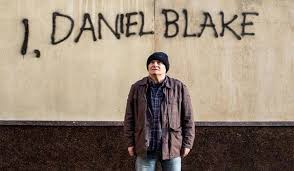 Yesterday I hosted an event at the wonderful Swindon Poetry Festival. As part of the evening I read the following poem ‘If We Were Real’, which was published in the Rialto; I then used it as the basis for a quiz. The following sixteen points, reference a film/book/play/TV programme, which portray the working class from the 1960s to the 2010s. It seemed to go down well, and the winner got ten out of sixteen, which under time constraints and not able access the Internet, was very good (the cheats know who they are). So, if you are that way inclined, why not have a go. No prize, just the personal satisfaction that comes from any pointless test of our memory. Only clue I will give is that they are all British and I Daniel Blake isn’t one of them. Please don’t post your answers in the comments section, as they will give it away for others. I’ll post the answers at the weekend and you can tell me what score you got in the comments then. Best of luck! (more…)
‘Persona Non Grata’ anthology edited by Isabelle Kenyon, with poem ‘The Refugees’ by Jennie E. Owen
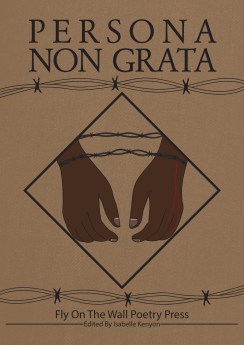 The other week, I was helping out Culture Matters at the Poetry Book Fair, hosting a reading with the wonderful Fran Lock and Nadia Drews, both of whom have upcoming collections with the press. Mike Quille and I shared the space with Andy Croft of Smokestack Books, and Isabelle Kenyon of the relatively new press, ‘Fly on the Wall Poetry’. Isabelle has been a tour-de-force on the poetry scene recently, first of all editing the mental health anthology, ‘Please Hear What I am Not Saying’, in support of the charity MIND. It was awarded ‘Runner Up for Best Anthology’ at the prestigious Saboteur Awards this May and to date, it has raised £500. (more…)
Why Poetry? The Lunar Poetry Podcast Anthology, with poem ‘what’s in yours?’ by Lizzy Turner

Just over three years ago I was sitting in the garden of a Kentish Town bar being interviewed by two special people, David and Lizzy Turner of Lunar Poetry Podcasts. Like myself with Proletarian Poetry (I was that night hosting an event at the Torriano Meeting House with Tim Wells and Anna Robinson), LPP had been going for less than a year, interviewing different poets about their poems and craft. David’s style of interviewing is one of the most laid back, yet incisive techniques I have come across; a great interviewer makes the interviewee feel they are just having a conversation, as opposed to a simple Q&A, and David does this with such aplomb. (more…)
But now by Stuart Charlesworth
I have thought quite a lot lately about jacking in poetry. Besides my dysfunctional health, the main reason is the frustration at poetry’s gated community who situate themselves far away in the wildlife of their own comfort; their liberal stance and inability to help us live a little bit better life by being the provocative fairground mirror to surrounding events. The somewhat disingenuous basis for the argument that, the reason most people hate poetry is because it doesn’t achieve what it sets out to do (i.e. be universal), means that its self-made pedestal is built on sand. I think a lot of poetry is an escape from life, not an engagement with it. By a lot, I mean that which is published in the magazines, whether online or in heavily over-submitted under-subscribed hard copy versions. There are glimmers of hope from across the Pond (Danez Smith, Eve Ewing, Terrance Hayes), but not a lot like that is prominent here in the UK poetry scene, and I would argue we are in the same shit pit as the US. (more…)
Mum’s Spicy Chicken by Nafeesa Hamid
Hegel infamously said that history was a process of thesis (the current paradigm) bumping up against antithesis, which then (through war, debate, demographics) becomes a synthesis, a resolve, whether it be chaos or calm. The rite of passage of a child is similar. The typical model is the young child being totally dependent on the carer, living by the values of their parents; they are helped, to walk, to speak, to read, etc.. Then, when reaching their teenage years, they become independent, at least in their eyes; wanting to go out more, liking different things, rebelling even. Eventually, in this theoretical scenario, the synthesis is interdependence, or rapprochement or mutual relationship of empathy; the young adult, gets a job, a family and realises what the other side of the coin looks like. (more…)
Guest Blog by Matt Duggan on Henry Hunt, with poem ‘The Orator of Peterloo’.
 Henry Hunt also known to some as the ‘Orator’, realised his talent for public speaking in the electoral politics of Bristol. Henry was highlighting the corruption of the ruling classes and the high tariffs given through mercantilist trade, where only landowners would benefit from it. Henry gave a radical speech at St Peter’s Field in Manchester on the 16th August 1819 which is known today as Peterloo (Named after the Battle of Waterloo). The Peterloo Massacre was caused by the over-reaction of local authorities, where 18 people were murdered. (more…)
A Collier’s Life by Steve Xerri
I have often said on this site that it is about the poems, less about the poets in terms of their social standing. In the readings I’ve done this year, I’ve met many people from different class backgrounds/foregrounds. I recently spoke with someone who had the least working class accent you will hear (think a notch or two down from William Rees MUG); yet, on talking with them, they spoke of their grandfather who had fought in the first world war, survived and went to work in the factories. I won’t go into accent as an indicator of class here, but there is sometimes a lineage from ‘Eee-by-gum’, to ‘Oh-Golly-Gosh’ (forgive the caricature) within a family.

‘Up and Away’ and ‘Full Strength’ by John Duffy
Up to the age of fifteen, my aunt and uncle would come over on Christmas day with my two cousins. They would arrive mid-morning, and we’d open presents, and my Uncle would crack some jokes and be on his best behaviour. Then at midday, he and my father would go down the pub, and my mum and aunty would prepare the dinner (my dad had already cooked the Turkey – up at 5am, slow roasting it). Us kids would play in the front room, which mainly involved me (some eight years older than my cousins and sister) trying to stop them from breaking my Subbuteo players. (more…)
 Proletarian Poetry