Deference. That key ingredient for soft power, even if it is enforced by hard methods (think of Putin or Trump). A lot would argue that deference is in decline. Figures on trust in public individuals, such as politicians, but also the media, are in decline. The internet allows for a greater challenge to authority than ever before (notwithstanding the ongoing battle over who controls it). Still, I think deference has a lot to answer for when it comes to injustices meted out by those who hold power.
When the archaeology of child abuse is finally dug up, a lot of what was allowed to go on, could be put down to deference. When I was at school, I was once hit on the head with a toffee hammer by a PE teacher for suggesting we play football instead of rugby for a change (this was a Hogwarts type grammar school, that allowed a few of the likes of us in). He cut my head and left a large lump. But I never thought to report it to anybody (not even my parents) because given the regime, I didn’t feel anyone would believe me. But this is such a minor example, given what is now being uncovered in other schools, churches, and institutions where children are under the tutelage of adults (scouts, football). Trust and deference go together.
In the past there were never the type of safeguards that are in place now. An authority figure, be they a priest, teacher, or coach, would command a level of trust given the position they held. But challenging that position, especially when your own values (e.g. religious) are invested in such people, meant that many were afraid to speak out. I know this from the experience of my local community growing up where the priest was a paedophile. Today, many of those parishioners can no longer look at photos of the happiest days of their lives (weddings, christenings, confirmation) because he is in the picture.
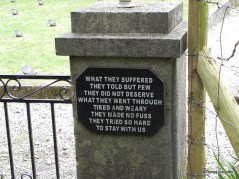 It seems there are never ending examples still emerging; in just the past week I have read reports of alleged abuse of children at a ‘therapeutic’ Christian farm in the US state of Georgia, and the discovery of mass graves of young children by unwed mothers in Tuam, Ireland. Doireann Ní Ghríofa’s haunting but beautifully written poem, At Letterfrack is an account of similar abuse at the Industrial School in Ireland that went back to the 1930s. It was so bad that boys would try to escape. “Ice grows on dormitory windows. Inside, rows of snores./Together, two boys whisper and dress in the dark. Hand in hand,/they run through white fields towards home.” But as the Ryan Report found, “they would usually be apprehended, sometimes by local people, and returned to the school.” On return, “they are beaten and sprayed with a hose.” One can hardly imagine how the perpetrators could defend such treatment. But people have great belief in the Faith and the institution of the Church; this trust is passed onto those who represent it, and were thus rarely challenged or questioned about their cruel practices.
Doireann Ní Ghríofa is a bilingual writer working both in Irish and English. Among her awards are the Rooney Prize for Irish Literature, the Michael Hartnett Prize, and the Ireland Chair of Poetry bursary. Her most recent book is ‘Oighear’. www.doireannnighriofa.com
At Letterfrack
From the Ryan Report on Industrial School Abuse, Volume 1,
Chapter 8, paragraph 162: “The children would run away at night
but they would usually be apprehended, sometimes by local people,
and returned to the school soon after.”
I
This bog of flattened bracken was once a vast forest,
filled with wildcats and wolves.
The bog still dreams of trees, buried deep, unseen.
II
Centuries ago, people build tougher roads here —
slats of wide wood hauled up and laid side by side
so treacherous wetlands of bog could be crossed.
These roads remain, far below the surfaced,
where years of peat grow over the past like scabs.
The bog swallows people and their paths.
The bog swallows itself.
III
Later, few trees grow
so people hunt the wood that lies below,
trunks of sunken forests buried in the bog.
At dawn, they seek patches of peat
where dew has disappeared, then pierce
the surface and push long rods deep,
deeper, through gulping ground
until they strike solid wood.
They pull chunks up and make rafters,
doorways, window frames.
From this land, a school and a spire rose.
IV
Behind the school, a path ends at a small gate–
small plot, small stones, where smalls letters spell small names.
Leaves whisper: there is nothing here to fear.
The earth holds small skulls like seeds.
V
Winter.
Ice grows on dormitory windows. Inside, rows of snores.
Together, two boys whisper and dress in the dark. Hand in hand,
they run through white fields towards home.
Does the land betray them?
No, a wizened hawthorn holds out hands to try to hide them.
VI
In winter, runaways are easily found. Even in the dark,
small bootprints break through white to the ground below.
Does the land betray them?
Yes, it shows their path through snow.
VII
They do not cry as they are dragged back, stripped of clothes,
pushed against the wall, their small feet sinking into snow.
There, they are beaten and sprayed with a hose.
Does the land protect them?
Yes, it holds their hands in the dark?
VIII
In dormitories of sleeping boys, they shiver and bleed
and weep black bogwater tears. Overhead, rafters dream
of their sunken mothers, submerged still,
deep in the bog.
Does the land protect them?
Yes, it stays under their fingernails forever.
IX
By March, the snow has returned to air, the footprints
disappeared. From the earth, buds open white petals to light
where wood anemones fill bog-paths with stars.
Do they hold onto this land?
No, they forget. They let go.
X
They boys grow up. They walk away.
They leave Letterfrack, and go to London, Dublin, Boston.
Through their dreams, the mountain cuts a stark shadow.
Do they hold onto this land?
Yes, it holds them hard always – as a scar silvers from a red welt,
it tightens at the throat like the notch of a belt.
At Letterfrack is from Doireann’s collection Clasp, published by Dedalus Press

 Catherine Graham’s poem Market Scene, Northern Town evokes this scene of bustling activity and its mix of goods: “The lidded stalls are laden with everything/from home-made cakes to hand-me-downs.” This is a tradition that is woven into daily activities: “They’ve/spilled out from early morning mass,/freshly blessed and raring to bag a bargain,/scudding across the cobbles, like shipyard workers/knocking off.” And from the food bought, you will “smell the pearl barley,/carrots, potatoes and onions, the stock bubbling/nicely in the pot.” We shouldn’t be too doom laden when it comes to the decline in markets, because they haven’t died out altogether, and I’m not sure they will. I for one would miss the market trader shouting, ‘Come ‘an ‘av a look. Pand a bowl!’
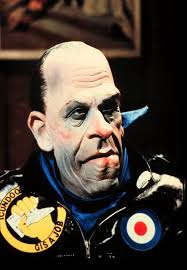
 Let’s start with a joke: “There’s a black fella, a Pakistani, and a Jew in a nightclub. What a fine example of an integrated community.” Here’s another one for ya, “Two homosexuals in the back of a van, having sex. They’re over twenty-one! What’s wrong with that?” These are the anti-stereotype jokes of
  If this site does one thing, I hope it shows that the working class are not a one dimensional, culturally barren, single type of person. Poems from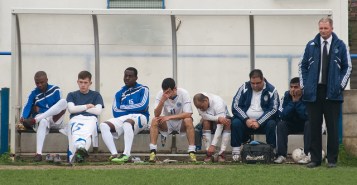
 Rishi Dastidar gives us a wonderful carousel of images of today’s modern Premier League players in his poem “We are Premier League”. The lines “We are Nando’s skin on X-box wings/We are charitable visits, making dreams come true”, shows the seeming contradictions of characters who command such wealth but still enjoy the ‘finer’ delights of chicken shops whilst visiting hospitals and schools. Many of these players themselves come from disadvantaged backgrounds, with little education (they were too good at football in their teens to worry about A levels, if not GCSEs) and travelled little. But like a lottery winner, the money can go to their head, and without proper guidance, they become: “We are court appearances in Armani suits/We are playthings of offshore corporations.” I wouldn’t go so far as to say they should be the foundation of a social mobility strategy, but neither should they be made the scapegoats of global capitalism. Many of the leading players, when retiring do a lot of good work supporting different communities. But there should be a way in which the benefits of cosmopolitanism can spread the income from globalisation more equitably; the football authorities are in a position to show leadership here, especially in these times of a resurgence in reactionary nationalism.

 Such a journey shows the continued fragility of the situation in the Balkans since its protracted war in the 1990s. In Katie Griffiths’ poem, A Lack of Minarets, she takes a journalistic eye to describe a particularly iconic moment in the war, that of Mostar and the destruction of its historic bridge. “From a distance something is wrong,/a skyline tampered with, hard edited./As the bus coils down the mountainside/into the basin of Mostar.” The city was a main route for refugees on their way to Split from Sarajevo. “This is the home of the dispossessed,/shunted like marbles from zone/to zone, who pick their way/past commandeered cars/and makeshift kiosks sprouting/at odd corners to replace/shops that once packed the town.” The city has since been rebuilt, which included restoration of the bridge to its original design. It took nearly ten years. Still, as with many wars, the return and rehabilitation of its citizens will take many more years.


 For those of us not able to do so, we are very lucky to have the likes of multi-talented Jemima Foxtrot who in a poem from her debut collection, All Damn Day, does what a lot of great poets do, allows us to dream. She takes a somewhat Manichean outlook that fits with the division we all feel in what we would like to do: “A half of me wants to exist in a tepee,/breed children who can braid hair and catch rabbits./Drink cocoa from half Coke cans twice a year/on their birthdays, the edges folded inwards/to protect their sleepy lips, cheap gloves to buffer their fingers,/precious marshmallows pronged on long mossy sticks.” However, such ‘rural and romantic poverty’ does not always fit with present circumstance, so we dream elsewhere. “If I were rich/I’d eat asparagus and egg,/in my Egyptian-cotton-coated bed, for breakfast. Bad. Ass./You’d find me in my limo, got a driver called Ricardo,/wears a nice hat. That’s that. Bad. Ass.” And in this dream we may travel to such places as Dorling suggests, but Jemima insightfully shows what lies at the heart these ‘hypocrisies’ we sit in, and how a division of one half or another can lead us all to a false sense of what it is we are after. “Capital has split my dreams in two /like a grapefruit./And I want both. And I want both.”
 This sets aside the history they have lived through and the people they became because of it; a World War to monumental technological change from the TV to virtual reality. They have so many stories to tell and be told, and Beth McDonough’s eponymous poem ‘St Fergus Gran’ does just that. “Great Gran lived in weighty old pennies, dropped/from bonehard hands to my fat-cup palm/just before we’d journey west.” Like many stories, hers is one that is handed down the generations, “I never knew of her second sight/All those deaths, and how she kent/her brother lived, when the telegram said not.” Their lives weren’t a straightforward one of getting married and having children; war put pay to that. “I met the East End Glasgow lad she’d/fostered in the war, with all his tricks, his walk/to her from the west coast up to Buchan.” Here Beth tells us a little more about the poem:
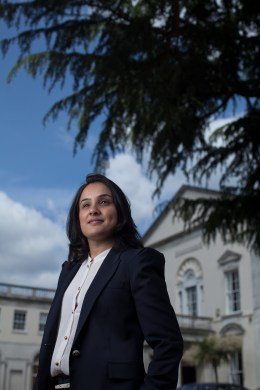 therefore have very different connotations. Our poet today, Professor Aisha K. Gill [
 In more wealthy countries people are also pressured to move. For example, because of past policies of selling off council housing,
 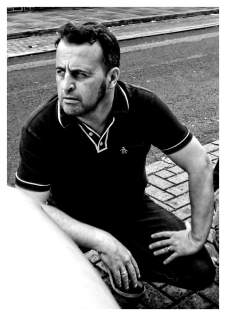 Nonetheless, whether a refugee who has left their country, or internally displaced person, the majority of people still call home the place they were born. Joe Horgan’s poem, “The Maps You Took With You When You Went,” tells of the place he was born, Birmingham and the situation facing many working class people during the 1980s. The irony being that many came to the city, as they did to my own home of Coventry, from Ireland and Scotland, only to see a number of their own children leave; some went back to Ireland during the Celtic Tiger bubble, whilst others dispersed to various corners of the country and abroad.
