Image by G Travels
We are coming to the end of the school year; a year full of turmoil instilled by a Government who feels it needs to do more than tinker with the education of our children, treating them more like guinea pigs in an ideological battle to send us back to Victorian times. Both education Secretaries (Gove and now Morgan), seem to want a war with teachers with the proposed imposition of academy status for all schools (thankfully withdrawn), new SATs for Year 6 students, and the madness of testing those under the grand old age of seven.
Governments still struggle with mass education; with classes of upwards of thirty children, herded together like cattle despite their different needs and abilities and family circumstance, all with the sole intention of getting them to pass a minimum of five GCSEs. I know from personal experience with my son that this can be really damaging to their future; that if they don’t attain these grades they feel like a failure. It drains the appetite of learning right out of them. All done without the seeming understanding of both what the teachers need and what therefore is good for the children.
 So, what then of the children both in school and then when they leave. Nadia Drew’s poem, “Like Mother,” shows us the variety of characters that can make up a class. “The flimsy, thin, sterling silver skin stinging slaps/The back of the class chatting up robbing from the stock cupboard smothered laughs/Julie, longing lashes, soft, leather wrapped in Frank/Debbie, bitty little. Biting lippy, outside the chippy/Gob full of fizz bomber jacketed hands jammed in high/Up in arms, sticking out like chicken wings, flapping/Clucking fuck this and fuck that.” Nadia poem looks at this from the perspective of a young woman’s rite of passage.
Having two sons of my own, I have felt that society is more set up for young boys; team sports such as football, rugby and cricket, and then when older the pubs with their own teams, are gendered to accommodate male activities and leisure. There is far less opportunity for girls and young women, “uniformly/Stubby short to skinny strip/Hanging from the tide marked neck/Now noosed round a reflection in a dressing table mirror/A face painted with disgrace/With no-one waiting till you washed it off/Full term came and went for some /An unmarked summer break becoming an endless spiral-bound roundabout/A mid-afternoon, windblown, swinging groan/With no bell ringing time to go home.” And then the child becomes a young adult, out of their teens and into a great open space of uncertainty. It is meant to be a time to be free to achieve those goals that were drummed into them.
Up to twelve years in an institution, getting them ready to earn and contribute, whether to parents with whom they still live because there is little affordable housing, or to society through paying taxes. But sadly, this is not for all. For example, not everyone can go to University, although the political mantra and investment has always been that this is what you should be striving for; the nobility of social mobility. “All your mates had to stay in evenings/Facing days framed by pram handles/And pacing familiar avenues/Dangling struggling little girls/Heavy with hope from the hip/Where you all used to stand about strangling laughs/Yanking tangles, swapping bangles.“
‘Everybody can be somebody’, is the Adidas-like mantra of my son’s school; well it all depends on how you define and measure what a ‘somebody’ is and whether you go on to repeat the life of another, ‘Like Mother’.
Nadia Drews was born in San Francisco and brought up in Greater Manchester. A Socialist mother with a suitcase of vinyl recordings by Leadbelly and Howlin’ Wolf and a well-earned Young Democrats badge led her to revolutionary politics and eventually to sing and write songs about changing the world first in the bedroom and then on stage. The stories of working class lives in the songs grew into plays and she left Manchester having written and co-produced ‘I Love Vinegar Vera (What Becomes of the Brokenhearted)’ based on the local legend of a woman that each Lancashire town seemed to have. Having moved closer to family roots in the East End of London in 2011 she began to perform poetry at the Poetry Cafe’s Poetry Unplugged night and then to become a Farrago Poetry Slam champion. Through this she has been able to start to find the ranting voice she was unable to achieve in the 80s. Thirty years of repressed rhymes mean she writes long poems…but she reads them fast.
Like Mother
Settle down, bottom set, poor concentration, what do you expect?
Failed tests, predictable results, staying behind red lines
Life viewed through windows in sticks, drizzling with tears of spilling piss
Clinging like dribble to chins of grizzling kids, you didn’t do what the other girls did
Tossed like crossings out on screwed up scraps
The Battersbys and the Bickerstaffes
The flimsy, thin, sterling silver skin stinging slaps
The back of the class chatting up robbing from the stock cupboard smothered laughs
Julie, longing lashes, soft, leather wrapped in Frank
Debbie, bitty little. Biting lippy, outside the chippy
Gob full of fizz bomber jacketed hands jammed in high
Up in arms, sticking out like chicken wings, flapping
Clucking fuck this and fuck that
Flicking V’s, not free to fly
Leanne, lanky, shrieking streak of ‘Miss!’
Witty, eyeing, disguised lined rims hidden behind
Sharp as a knife flicked fringe
Shading every ‘shameful’ cringe
All subjects of so much rigid invigilation
Tiddy-tipped, spit slippy, wetly dreamt of unplanned examination
Cupped like slurped chipped china cups spilled in saucers of your warmth
Held in belched petrol smells, cider swilled with fry –ups
Eyeing up, weighing out, measured in points for their pleasure
Stiff inches of sin counting you on scribbling fingers
Summing you up, in and out scratching walls
Hurtful mis-spelt spurting words
Running out and leaving
Stale-tasting tell-tale stained pockets of cock-eyed explanations
After all those years of teaching you lessons
Never reading your need to know
NO …..NO…..NO
Minus one of them speccy gets noticed you go
Woe betide you’d ever forget it-they checked, uniformly
Stubby short to skinny strip
Hanging from the tide marked neck
Now noosed round a reflection in a dressing table mirror
A face painted with disgrace
With no-one waiting till you washed it off
Full term came and went for some
An unmarked summer break becoming an endless spiral-bound roundabout
A mid-afternoon, windblown, swinging groan
With no bell ringing time to go home
Down the dole to drum on doors hard
Then a card and a ticking clock
On the Verdigris, smocked copper bonnet, factory top
Making dull days, patinaed with wages
Catalogued to pay for life in reasonable instalments
24 or 36 weeks
Outfits in drips to disguise your defeat down the pub
Atmosphere thickly misted stinking with chart hits
Spewing what was up supped in the gutter
Up against a throbbing, glugging fug
Filling up belly-aching gaps, swallowing laughs, tapping off happiness
Getting ribbed, coins banged in avoiding trouble
Chasing, knocking back, seeing double
Others would try to get in the club
The price was too high for you to pay
And you were too old to run away again
All your mates had to stay in evenings
Facing days framed by pram handles
And pacing familiar avenues
Dangling struggling little girls
Heavy with hope from the hip
Where you all used to stand about strangling laughs
Yanking tangles, swapping bangles
Mixed up ten pence teeth sticking sweet dreams
Twisted in bags ripped from string
Escaping tear away paper thin lips
Skinned suckling pale pink dissolving flying saucers
Sore ochre cracked with sleeping smiles inside
That mithered mothers now bribe their daughters with
Outside Claire’s shop beyond the school gates when you were meant to stop
You paid your debts to Great Universal
Ticking the box to say you would no longer like to be a representative
And walked out in a patent leather patiently anticipated excellent value for you shoe
Through the front door this time
With your mum’s packed away sadness and matching set of unused suitcases for all occasions
Full of qualifications to be somewhere else
And you slipped into the empty seat on the empty bus
Like a popped in pear drop from a shared quarter
Passed between mother and daughter sat on the sofa staring at the blaring telly
Yelling jokes at soaps her stroking your hair and hoping.
 Well the European Union is to lose a member. Maybe it will lose other members. Maybe it will be the end of the Union. What it won’t make a difference to (at least in positive terms), are the crises from Libya to Afghanistan that see thousands of refugees attempting to come to European shores. I am not going to get into the reasons for this fracture in European politics, which is as worrying at it has been since WW2. But one reason is not immigration. I don’t mean people didn’t vote with immigration as an issue, what I mean is that, whether there is an EU or not, it won’t make the slightest difference to these war torn people. And that is the shame of the referendum, which in my opinion should not have been undertaken. It was an ego trip of Cameron to have a legacy; well he’s got one now, but like Blair, it’s not the one he wanted.
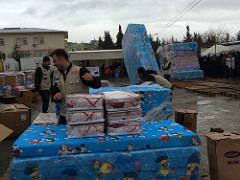
 The other sad irony of the decision to Leave is that the United Kingdom couldn’t be further away (in European terms) from the influx of large numbers of refugees. Added to this tragedy has been the fact that this has been left to the most crisis ridden country in Europe, Greece, to deal with it. Emer Davis shows us first-hand the situation facing Greece during this time in her poignant poem, Transient Lives. (Emer was selected as an asylum expert to assist the European Asylum Support Office (EASO) with the EU Relocation Programme on Lesvos Island). “Lesbos/Home to ouzo/And olive oil,/Cobbled lanes and wooden balconies,/The rambling stillness/Of the petrified forest,/Burnt skin trembling/Among dead trees,/We tremble in the evening sun/Re-telling the stories we heard,/And watch an old fisherman Bashing an octopus against a wall.”
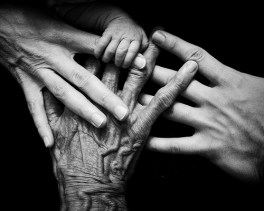
  At the birth of my first son, after a somewhat traumatic first week of his life, my father said to me, in his dry wit, “You’ve a lifetime of worry ahead of you. When you’re 80 and he’s 50, you’ll still feel the same.” Now my father is in his 80s, for me the worry works both ways, to my teenage sons as well as my parents. The greatest parental experience I have had is becoming a stay-at-home/househusband/underling of my two sons some eight years ago. I was brought front stage on the gender divide of parenting; evidenced at first hand the plates mothers are juggling, as many of my new plates smashed on the floor.
 My father was one of them, and so was David Cooke’s, whose father opted for retirement in his very early fifties, and is the subject of his poem, “Work”. His father was “a ‘man’s man’ my mother said, who needed/a joke to keep him going, and something to get him up in the morning besides/a late stroll to place his bets at Coral.” As a young son or daughter, the roles of your parents are defined by their actions; of what they do, and in them days it was the father who was out all day at work. So when he is made redundant, he is lost. “I’d learn that no one’s indispensable./So after he’d botched a shed, dug the pond/and built a rockery, the time was ripe/for change.” They had worked all their lives and didn’t want to lay fallow on the dole. My own father went on to do different jobs, as did David’s who “With a clapped-out van and a mate,/he started again on small extensions.”
 As we slowly make our way to the voting booth for the EU referendum, what has struck me is
  Jasmine Ann Cooray’s poem, Ice-cream Box of Frozen Curry beautifully expresses this generational difference from her experience being of Sri Lankan and mixed European lineage. The poem conveys the journey of a newcomer to the country, the people they leave behind (“Dear village leavers/Dear fortune seekers/Dear don’t forget us/Dear whispered prayers”), and the new rules and racism the leavers experience (“Dear name,/Dear get to work/Dear roads and railways/Dear NHS/Dear filthy Paki/Dear bite your tongue”). This is an immense a coming-of-age/rights of passage story that is both funny and sad, matching the older generation (Dear ice-cream box of frozen curry/Dear tiny aunts with iron grip/Dear random portly shouting uncles/Dear grandma wince at dodgy hip) with the ways the younger generation try to create their own identity (Dear make-up practise after lights off/Dear boyfriend legs it out the back/Dear promise I was in the library/Dear shaving threading bleaching wax).
  In computing, Moore’s Law stated that the overall processing power of a computer would double every two years. This has literally powered the start of a wave of technological development, whose social impact is unfathomable, especially if we remember we are still the same cognitive creatures we were hundreds of years ago, when things changed at a far slower pace. This is both frightening and exciting and has accelerated the outcome of international capitalism – globalisation; that great sway of moving things, from people to pins.
 Mike Gallagher’s powerful poem, Paraic and Jack and John, tells a familiar story of the Irish diaspora, who have left to go to the UK, America and elsewhere, and the gap this left for those still living in Ireland. “not too many options there,/the bus up Gowlawám,/the train to Westland Row./Holyhead gave them choices:/Preston? Ormskirk? Cricklewood?” These men traversed the 260 mile long A5 road that runs from Holyhead on the Welsh island of Anglesey all the way to London and the Kilburn Road.
 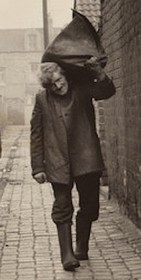 Readers of this blog are well aware of the impact Thatcher’s policies had on the coal mining industry during the 1980s. There have been a number of poems addressing the experience faced by the miners in their fight to secure the livelihoods. However, the impact was much wider than just those working at the coalface (sic). Besides the local shops gaining from a miner’s income, there were also those who delivered the coal – the coal merchants.
 Patrick Barron’s poem “The Coalmen” takes the point of view of a young child looking out their bedroom window at these black and grey men, carrying huge sacks weighing up to 50 kg, “as if they were carrying their own mothers across a river.” There is something of the mythical about these men, as though they were in disguise, as though they weren’t meant to be seen, shadows almost.
  “When I first heard some geezer called Martin Anus had written my life story I was chuffed. Weren’t surprised like cos I know I’m a top bloke and that. But then me mate told me it was what you would call an unauthorised biography and that he hadn’t painted a good picture of me. And I thought, how could some no mark write about my life without me knowing, or without even speaking to me? So before taking the time to find him and chop off his head off, I took to reading it. And what a load of old bollocks it is was as well. Okay, a lot of it is true, such as the beatings I dished out, and prison, and how me nephew is shagging my mum, but the rest is bullshit.”
 A reader or listener can tell if the poem lacks these ingredients, which betrays, what Fran Lock, pointedly describes as ventriloquism. And as much as I try not to provoke class war on the site, there does come a time when you get angry at such false representation, especially when you read ‘On Ventriloquism‘, such a brilliant and unrelenting poetic diatribe in response to a recent experience at an open mic. So Martin Amis, fuck off will you!
  Propaganda and censorship are the recognised tools of government; whether that government be the so called western liberal kind, or one more akin to North Korea. Of course, they use different methods in the use of these tools but essentially they serve the same purpose of maintaining power, done in the guise of protecting the values, ethos, or way of life of its citizens. Violent conflict is
  And it is children, who are the most vulnerable civilian casualty of them all. Michael Rosen highlights this tragedy chillingly in his poem Don’t Mention the Children. The poem refers to the
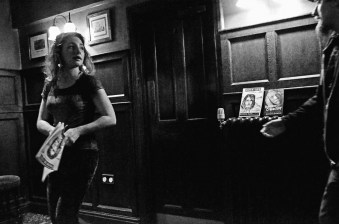
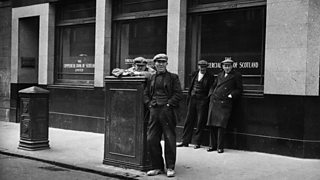 In the late 1940s, my father and his friend (both aged 14) were sitting in a pub in Glasgow. Two middle-aged drunk men were sat at the bar; they were well known local gang leaders from the notorious thirties. One of the men turned to other: “I dare you to stick this glass in my face,” he said in a fading act of bravado. “No, I dare you to stick it in my face,” replied his sparring partner. So the first man did. Blood burst from his face and the stools went over. But instead of going at each other, they left together to seek out the nearest hospital (Try reading
  But let’s forget about the pubs’ demise for now and engage in a bit of nostalgia with Julia Webb’s funny and riotous poem, Friday Night King’s Head. This is a pub you would love to go to, if only to be a fly on the wall. “Some girl is pulling another girl’s hair and screaming, and some other girls are in the loo skinning up, and Andy is trying to force his way into the Ladies with his watery eyes, wet lips and flat cap.” Pubs are more than their insides, especially in the summer, when people spill out into the car park, the garden or the wall. “there’s a row going on outside, a Cortina is revving its engine, and someone is laughing, it sounds like a tree full of monkeys, but when you go outside it’s just the usual crowd sitting on the wall around the tree smoking.”
  Proletarian Poetry