Poem

The Out of Town Shuffle at the Poetry Cafe

photo (7)

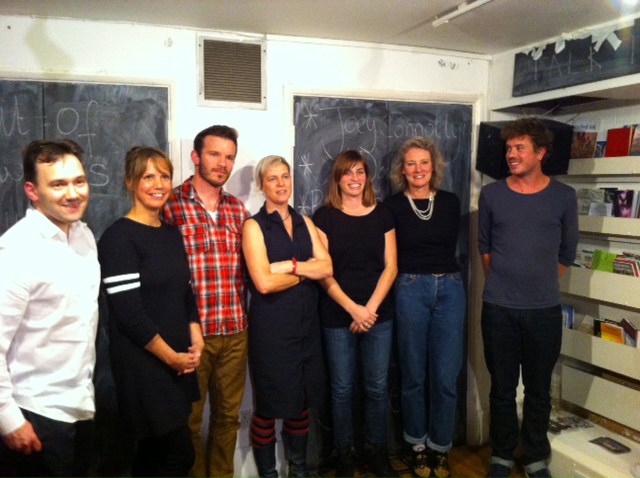
Andrew Smardon, Hilda Sheehan, Brad Schmauss, Jo Bell, Kim Moore, Liz Dorfman, Joey Connolly

Poets really are a welcoming bunch. Standing at the bar of the Poetry Café last night, I introduced myself to Kim Moore, who like Jo Bell at the Forward Prize, invited me to join her and friends before the readings (I didn’t quite get to the bottom of why Hilda Sheehan ended up in a freezer in Lidl, or was it Aldi?).

I was there for The Shuffle to hear seven poets from ‘out of town’ organised and hosted by Jill Abram. I liked the way Jill introduced the poets by reading a poem for each of them (she meets a lot of people, mainly on residential writing courses as far as I can gather). (more…)


Raymond Antrobus Conversation with a Man in Wetherspoon’s

raymond antrobus picIn 1988, one of Thatcher’s dying policies to keep the working classes ‘happy’ was all day drinking. At the time we loved it. For me personally, working in the bookies, it meant not having the 3.30 pm spill out of drunks rushing the counter with bets. Needless to say my boss wasn’t happy with the loss of losers. One thing that became a fixture when the novelty wore off, was The Monday Club, the counterintuitive antidote to a weekend binge – drink all day on the Monday. Good times, good times.

Anyhow, the first line of today’s featured poem by Raymond Antrobus, really hit home (Wetherspoon’s on a Monday morning is like a retirement home). For many this goes beyond the simile. This poem is a wonderful divide between Ray setting the scene, (no-one takes off their jacket/they won’t admit how comfortable they are) and the verbatim story of the man’s life (Home is complicated now because I know too many places that it might be and not all of them exist). And there is the mix of nice humour (it’s hard to be honest in the same country you do your taxes) and the sad (it’s hard to love someone when you know them too well). But this is a poem about place and identity; of where you come from, where you live, where you would like to live, and therefore the importance of place in identifying who you are. (more…)

Helen Mort – last orders for chesterfield

Helen Mort 1Today’s poem is ‘last orders for chesterfield’ and sees the author moving invisible through a town as it crosses night with day (night-shift workers going home). The imagery conveys Spring set in decay (a rusty bicycle, russet skeletons of cars) with the writer unseen by locals (the waiting drivers don’t look up or step aside to let me pass), her history erased (the churchyard wall is clean of my dark signature), and yet in some small way, the spirit of her remains (he might pause to wonder what it is that seems to stir). This is a dark and sad poem (when I reach my parents’ house it will be overgrown with waist high-nettles) but it is not maudlin nor does it demonise the characters it portrays, besides of course the taxi driver who quickly turns from hero to villain (the lass he rescued, ‘the slapper was locked out’)

Helen began her poetic writing as a ghost in a pub; her first pamphlet, ‘a pint for the ghost’ is a memoir of a time now lost but still resonates in the mind. It is a set of poems that Helen has performed as a sequence, a running monologue of different characters, in ‘worked-out mines, smoky pubs, and deserted highways’. (more…)

Imtiaz Dharker – Living Space

Imtiaz Dharker picToday’s poem is by Imtiaz Dharker. Imtiaz is appearing on all round nice man Ian McMillan’s The Verb on Radio 3 on Friday 24th October at 10pm, so I wanted to feature her poem, Living Space. I feel it relates to Kei Millar’s This Zinc Roof because of the link with the fragility of the home in the developing world, where it is a metaphor for a whole country – ‘the whole structure leans dangerously towards the miraculous’.

I have also included Imtiaz reading from two of her poems on Bloodaxe, of which I particularly like, ‘They’ll say, “She must be from another country.” ‘ This is from a DVD of 30 poets reading their work.

(more…)

Anna Robinson’s Portraits of Women – East London 1888

Anna Robinson picToday’s poems (for there are five as part of a set) are by Anna Robinson from her collection, The Finders of London. I would say that Anna herself is a finder of London as she uses poetry to show a history of the capital from a different perspective, following a tradition that goes back to Henry Mayhew’s classic ‘London Labour and the London Poor‘.

She does this so well in these prose poems, which strip away the sensationalism and misogyny so inherent in portrayals of the Whitechapel/Ripper murders, leaving us with a rich description of these women’s lives in the year 1888. These are women who may be full of contradictions (She does not drink except for rum) have fallen foul of the law (She has been arrested for impersonating a fire engine down Aldgate) and are controlled by men, but they find ways round (She keeps a key in her petticoat pocket. It is for the padlock the waterman uses to try to make her stay). The shadow of these women’s fate makes these poems tragic but they are also funny and uplifting, and give us a picture of London’s Victorian poor from a new angle. (more…)

Debris Stevenson’s Quality Street

debris stevenson pic

Debris Stevenson

Today’s featured poem is by Debris Stevenson from her pamphlet collection Pigeon PartyQuality Street takes a family day out by the seaside (Skegness) ‘Forgetting about Christmas and holiday pay’ and shows the love between parents, ‘Mum and Dad, one cod, one kipper, sit on the pier, touch knees’, and the real existential threat posed by seagulls to our staple fish and chips, as they ‘see pick-nick families – unhappy and hungry’.

Debris is one of a growing number of young British poets who, in her own words, ‘like poems spoken, written, sung’. I saw her at Wordsmith’s & Co at Warwick University where I could see the performance of her poetry but also its lyricism, which really came through when I read Pigeon Party. (more…)

Steve Ely’s Shitneck – Playing the Name Game

Steve ElyFollowing on the heels of my post on Paul Summers, Jo Bell kindly (again) suggested Steve Ely and in turn he offered today’s featured poem, Shitneck (on the Wimpey’s Estate in South Kirkby).

I really like this poem because it reminds me of the way in which young people take on nicknames. My own experience was that you either had an ‘o’ (Dicko, Docko, Stevo) or a ‘y’ (Whaley, Gordy, Murphy – okay that last one was actually a name doubling up as a nickname) put at the end of your name or some derivation of it. I was Scotty because my Father was from Glasgow.

This also relates to how word association is used in vernacular speech. And although Shitneck is about this, as with any good poem it is much more, for Steve shows the harsh hierarchy inherent in such friendships and how your nickname can position you within it. (more…)

Karen McCarthy Woolf’s Hoxton Stories


Karen McCarthy WoolfKaren McCarthy Woolf‘s Hoxton Stories are vernacular poems of her grandfather’s experience growing up in the area. Here is featured, Guy Fawkes Night, taken from Modern Poetry in Translation Dialect of the Tribe. I have written poems taken from my Father’s verbatim experience of living within the pages of Angela’s Ashes, (for him it was Glasgow) but never thought of it as translation. But thinking about it, that is what it is; maybe not in the literal sense of how we understand translation as a foreign language, but in the vernacular sense. Translation is more than understanding or comprehending, it is about empathizing with, not only people’s experience but their culture. This is summed up in the final beautiful and direct words of her grandfather, ‘So what d’ya reckon about that one then?’ Well, what d’ya reckon?

Karen has recently published “An Aviary of Small Birds.”

www.karenmccarthy.co.uk

Twitter: @KMcCarthyWoolf


(more…)

Liz Berry and the Music of the Vernacular

Black-Country-Final1The Black Country by Liz Berry is a wonderful contemporary example of vernacular poetry. It goes beyond mere dialect to use the words as a way of conveying meaning and music. Elsewhere, the novels of the likes of James Kelman or Roddy Doyle use dialect to great effect in conveying working class life in Glasgow and Dublin. And Liz Berry does this in her poems about the Black Country and surrounds. To help us along, she even features translated words at the end of each poem.

http://lizberrypoetry.co.uk/

Twitter: @MissLizBerry

Best of luck to Liz tonight at Forward Prize for first collection.

(more…)