At the birth of my first son, after a somewhat traumatic first week of his life, my father said to me, in his dry wit, “You’ve a lifetime of worry ahead of you. When you’re 80 and he’s 50, you’ll still feel the same.” Now my father is in his 80s, for me the worry works both ways, to my teenage sons as well as my parents. The greatest parental experience I have had is becoming a stay-at-home/househusband/underling of my two sons some eight years ago. I was brought front stage on the gender divide of parenting; evidenced at first hand the plates mothers are juggling, as many of my new plates smashed on the floor.
The fluidity of parental roles is more dilute than it has ever been. This is most certainly a good thing, but it also leads to uncertainty as to the gender roles each partner should play, mainly because the ‘economics’ are still paramount, especially when women continue to be discriminated against.
After the Second World War (up until Thatcher), there was a general consensus across political parties as to the basic tenets of the country’s objectives for its citizens, one of which was full employment – a job for life. The first bricks were taken out of this wall during the 1980s, and those men, now well into their seventies and eigthies, were being made redundant some ten or more years before pensionable age.
My father was one of them, and so was David Cooke’s, whose father opted for retirement in his very early fifties, and is the subject of his poem, “Work”. His father was “a ‘man’s man’ my mother said, who needed/a joke to keep him going, and something to get him up in the morning besides/a late stroll to place his bets at Coral.” As a young son or daughter, the roles of your parents are defined by their actions; of what they do, and in them days it was the father who was out all day at work. So when he is made redundant, he is lost. “I’d learn that no one’s indispensable./So after he’d botched a shed, dug the pond/and built a rockery, the time was ripe/for change.” They had worked all their lives and didn’t want to lay fallow on the dole. My own father went on to do different jobs, as did David’s who “With a clapped-out van and a mate,/he started again on small extensions.”
As we slowly make our way to the voting booth for the EU referendum, what has struck me is the divide between the young and old; opinion polls show an almost equidistant difference between the young who want to remain, and old who wish to leave. But this type of generational divide can be seen in lots of other ways; different histories of course, which then influence the socio-economic and thus political positions of the young and old. One problem, at least the higher income countries, is the gap between the baby boomers who are being blamed for keeping all the post-war socially secure wealth (e.g. pensions), and the millennials who will have to work forever, which is okay because technology will allow us to live that long.
But one of the age old (sic) differences is of culture; especially for those whose parents come from a different country, who may be more conservative or religious, and wish to pass on their ethos to their children, which they feel is the natural job of a parent. From my own background, my friends were made to go to church, but would often just nip in at the start of a service to see who the Priest was, then spend the next hour round the back smoking before going home and saying that Father such and such was the man at the altar to prove their presence to their mother.
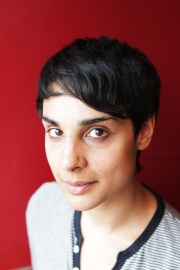
Jasmine Ann Cooray’s poem, Ice-cream Box of Frozen Curry beautifully expresses this generational difference from her experience being of Sri Lankan and mixed European lineage. The poem conveys the journey of a newcomer to the country, the people they leave behind (“Dear village leavers/Dear fortune seekers/Dear don’t forget us/Dear whispered prayers”), and the new rules and racism the leavers experience (“Dear name,/Dear get to work/Dear roads and railways/Dear NHS/Dear filthy Paki/Dear bite your tongue”). This is an immense a coming-of-age/rights of passage story that is both funny and sad, matching the older generation (Dear ice-cream box of frozen curry/Dear tiny aunts with iron grip/Dear random portly shouting uncles/Dear grandma wince at dodgy hip) with the ways the younger generation try to create their own identity (Dear make-up practise after lights off/Dear boyfriend legs it out the back/Dear promise I was in the library/Dear shaving threading bleaching wax). (more…)
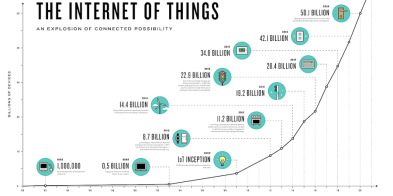
In computing, Moore’s Law stated that the overall processing power of a computer would double every two years. This has literally powered the start of a wave of technological development, whose social impact is unfathomable, especially if we remember we are still the same cognitive creatures we were hundreds of years ago, when things changed at a far slower pace. This is both frightening and exciting and has accelerated the outcome of international capitalism – globalisation; that great sway of moving things, from people to pins.
Around 2009, more people lived in cities and urban areas, than in rural parts for the first time in history. Partly explained by population growth it is also to do with mass migration to the expectant honeypots of city life, both in home countries and abroad. Those who work in the cities, sometimes leaving their families for many months or even years, send much needed money back to family members who are no longer able to make a living from the countryside. In the Philippines for example, ten percent of its population work overseas, generating some $25 billion in remittances to their home economy (10% of its GDP). But I have always wondered what of the country without the ten percent of its population. What effect can this have?
Mike Gallagher’s powerful poem, Paraic and Jack and John, tells a familiar story of the Irish diaspora, who have left to go to the UK, America and elsewhere, and the gap this left for those still living in Ireland. “not too many options there,/the bus up Gowlawám,/the train to Westland Row./Holyhead gave them choices:/Preston? Ormskirk? Cricklewood?” These men traversed the 260 mile long A5 road that runs from Holyhead on the Welsh island of Anglesey all the way to London and the Kilburn Road. (more…)
Readers of this blog are well aware of the impact Thatcher’s policies had on the coal mining industry during the 1980s. There have been a number of poems addressing the experience faced by the miners in their fight to secure the livelihoods. However, the impact was much wider than just those working at the coalface (sic). Besides the local shops gaining from a miner’s income, there were also those who delivered the coal – the coal merchants.
Like many in the industry this was hard work, and given the fact it was most needed in winter, the delivery of coal was often freezing work. Delivery was the end point, there was much work to get the coal into the sacks; heavy shovelling and when frozen, the coal would come in great lumps that needed separating. Horse and cart made way for trucks by the middle of the 20th century. The ‘coalies’ didn’t have a uniform as such, but there was a dress code as they were dealing with the general public. They would wear leather backed hats, to protect their shoulders and head; they also wore ‘spankers’, which were straps just above the knee to stop coal dust going up their legs.
Patrick Barron’s poem “The Coalmen” takes the point of view of a young child looking out their bedroom window at these black and grey men, carrying huge sacks weighing up to 50 kg, “as if they were carrying their own mothers across a river.” There is something of the mythical about these men, as though they were in disguise, as though they weren’t meant to be seen, shadows almost. (more…)
Many poets improve their skills through writing classes and groups; whether with organisations and colleges or with self-organised like-minded people. But what happens when the course or group finishes and you’re poems are ‘ready’ for the world to read. Competition in publishing, as we all know is immense and can be a very dispiriting and lonely experience. Here is how one group of women in the North East of England responded.
Marilyn Longstaff of Vane Women
Vane Women is a women’s collective celebrating its 25th anniversary this year. It promotes good writing by organising workshops, mentoring and hosting masterclasses by established writers. It was founded in 1991 to support the development and recognition of women writers in the North East. The writing, publishing and performing collective has come a long way from its beginnings in a women’s writing class at the late lamented Darlington Arts Centre, Vane Terrace.
This past Sunday (the 8th May), was the penultimate day of the English summer. The weight of people walking around London, was lightened by their lack of clothes and perspiration. We are now descending into autumn, whilst Scotland still basks in the mid-20s. But I spent much of Sunday indoors, preparing and fretting over that evening’s events in Kentish Town.
The first was a conversation with David Turner and Lizzy of Lunar Poetry Podcasts. David, in little over a year has carried out 75 interviews with people here in the UK poetry world. It is a great endeavour, and one I hope gains a lot of interest. We spoke of course about Proletarian Poetry, but also issues relating to class more generally, poetry genres and readers, and valuing poets (i.e. with £). Have a listen, and try to check out some of the other interviews.
Then, I was very proud to be part of the long tradition by hosting the Sunday poetry reading at the Torriano Meeting House. The Torriano has been going for many years; in fact, my mother-in-law who came along on the night, used to go there more than twenty years ago. I was so pleased to have Anna Robinson and Tim Wells as the guest readers, along with some great open mics from Grim Chip and Nadia Drews, and a short set from myself. So although it was one of the hottest days of the year, which I didn’t see much of, it was well worth the effort. Onwards (with a brolly!).
“When I first heard some geezer called Martin Anus had written my life story I was chuffed. Weren’t surprised like cos I know I’m a top bloke and that. But then me mate told me it was what you would call an unauthorised biography and that he hadn’t painted a good picture of me. And I thought, how could some no mark write about my life without me knowing, or without even speaking to me? So before taking the time to find him and chop off his head off, I took to reading it. And what a load of old bollocks it is was as well. Okay, a lot of it is true, such as the beatings I dished out, and prison, and how me nephew is shagging my mum, but the rest is bullshit.” (Review of Lionel Asbo by Martin Amis by Lionel Asbo)
There is a long history of cultural appropriation far worse than that done by the likes of Amis when usurping the voice of the working class. Most notable is racial theft that ranges from the Black and White Minstrels to people self-identifying as being of different heritage to that they were born into. In terms of art, it is like a venal plagiarism; passing your own work off as authentic is the height of disrespect to the heritage it was derived from. Just ask Chuck Berry.
Proletarian Poetry is about the poems, not the background of the poets. It doesn’t matter if the poet doesn’t play bingo or leave their kids in the car with pop and crisps while they get pissed in the pub. Of course, that might help if that’s what the poem is about and it doesn’t demonise. But a poem needs to be truthful and authentic, have imagination and resonance. Just read the poems on this site, for example by Kim Moore (My People) to see the diversity of the working classes.
A reader or listener can tell if the poem lacks these ingredients, which betrays, what Fran Lock, pointedly describes as ventriloquism. And as much as I try not to provoke class war on the site, there does come a time when you get angry at such false representation, especially when you read ‘On Ventriloquism‘, such a brilliant and unrelenting poetic diatribe in response to a recent experience at an open mic. So Martin Amis, fuck off will you! (more…)
Collateral damage. Casualties of war. Seen but not heard. Neither seen nor heard. There are none. They don’t exist. They are the cradle of terrorists. Rubble is their toy. Ideas are their weapons. They are not children. They can’t be children. Let us not hear of such things.
Propaganda and censorship are the recognised tools of government; whether that government be the so called western liberal kind, or one more akin to North Korea. Of course, they use different methods in the use of these tools but essentially they serve the same purpose of maintaining power, done in the guise of protecting the values, ethos, or way of life of its citizens. Violent conflict is famously said to be an extension of such forms of politics, but by other means.
War is a different beast than it was a hundred years ago; the dead of the First World War were soldiers. Because of the aerial bombardments characteristic of the Second World War there were far more civilians killed. Today’s wars are said to be different than any other because the fight is now between states and non-state actors (aka terrorists/freedom fighters). But what is common in this new form of warfare to the WW2 is the amount of innocent civilians killed. Actors on both sides, whether through suicide bombs, drones, or barrel bombs are indiscriminate in trying to achieve their bloody aim.
And it is children, who are the most vulnerable civilian casualty of them all. Michael Rosen highlights this tragedy chillingly in his poem Don’t Mention the Children. The poem refers to the banning by the Israeli Broadcasting Authority of an advertisement by the human rights organisation B’Tselem, where it listed the names of the children killed during the bombing in Gaza by Israel. Every country has its right to defend itself; however, it is an issue of proportionality, which lies at the heart of any response. (Bernie Sanders recently challenged Hilary Clinton over this matter, and she refused to condemn the bombing as being disproportionate). So Michael shows how ridiculous this ban was: “The names of the children must be hidden./The children must be nameless./The children must leave this world/having no names.” Only by erasing such acts from history, can they be kept from the world’s view allowing future actions to continue.
Here is Michael reading the poem:
But not only should we mention the children, let us hear what they have to say themselves. Let’s listen to the children. Here is one short account of a nine year old’s experience of the bombing in Gaza in 2014:
“Even our apartment has been bombed. The aim is to make us displaced in UN schools and then be a target for tank shells. As you see we had our three shops completely destroyed, but I know fully in my heart that God will compensate us. Till the last day of the war, we remained in our apartment, but when the apartment next door sustained damages, we ran to seek shelter at my grandpa’s place in Shujayea, and there it was bombed again. We ended up going to relatives in the west. There is nowhere safe. Even al-Shifa hospital has been targeted.” (Osama Ejelah, aged 9)
Michael Rosenwas born in North London in 1946. His parents were both teachers. After university he worked for the BBC on Play School and Schools TV. He currently presents Radio 4’s long-running Word of Mouth. His many awards include the Eleanor Farjeon Award for distinguished services to children’s literature. He is the Chevalier de l’ordre des artes et des lettres and was Children’s Laureate from 2007-9. He is Professor of Children’s Literature at Goldsmith’s, University of London. Don’t Mention the Children is taken from his collection of the same name published by Smokestack Books in 2015.
Don’t Mention the Children ‘Israel bans radio advert listing names of children killed in Gaza.’ Guardian, 24 July 2014
Don’t mention the children.
Don’t name the dead children.
The people must not know the names
of the dead children.
The names of the children must be hidden.
The children must be nameless.
The children must leave this world
having no names.
No one must know the names of
the dead children.
No one must say the names of
the dead children.
No one must even think that the children
have names.
People must understand that it would be dangerous
to know the names of the children.
The people must be protected from
knowing the names of the children.
The names of the children could spread
like wildfire.
The people would not be safe if they knew
the names of the children.
Don’t name the dead children.
Don’t remember the dead children.
Don’t think of the dead children.
Don’t say: ‘dead children’.
At which point the butterfly of globalisation first flapped its wing has been the focus of historical debate for many years. Some suggest that it goes back to Roman times and the imposition of ‘foreign’ forms of economic and social development throughout Europe – hence ‘what did they ever do for us’! But I see modern globalisation being about scale and worldwide integration of all forms of capital, some of which are good (raising levels of empathy and understanding of different cultures), some of which are bad (where capitalism soaks the pores of every crevice).
In more recent times globalisation reached its potential through deregulation during the Thatcher/Reagan era that released the bats of profiteering we see today in the long tail of economic inequality. This followed the shock oil price controls by OPEC, in the early 70s; which was the beginning of non-Western hegemony with the spread of global assets by today’s new economic powers from Dubai to Dehli to Beijing. Capital flows as quickly as the oil through transcontinental pipes, so we now have Indian companies owning British-based manufacturing and deciding the fate of Welsh and English steel workers. The origin of ownership doesn’t matter per se. But global capitalism is run in the same way whatever the cultural heritage as we see with ‘communist’ China. Owners may be hedge funds or political dictators, they are all driven by profit and their managers are their enforcers.
Image by John Briggs
Gemma June Howell’s poignant ballad, ‘Abide the Bosses’ Law’, inspired by the Rhondda Riots (aka Tonypandy riots) over one hundred years ago, resonates to this day. “Our women cradled flasks of tea/while we clasped wooden sticks. /The kids looked on with hungry eyes,/We miners had thrown down our picks!” An oligopoly of mine owners had set prices and wages to the obvious detriment of the workers. “Though starving half to death out there/our wills were strong as iron./We wouldn’t take this lying down,/each man with the heart of a lion.” (more…)
On Wednesday 6th April, Proletarian Poetry took over the Poetry Library as part of their Special Editions series. With the poets, Mona Arshi, Rishi Dastidar, Fran Lock, Clare Pollard, Richard Skinner, and Laila Sumpton, this was always going to attract a full house. For those unfortunate enough to miss the event, there is a link to a recording of all six poets readings below, and introductions from myself (I have included in the latter the time in the recording the poet started reading and a link to the original poem featured on the site). I hope you enjoy it as much as I did.
 At the birth of my first son, after a somewhat traumatic first week of his life, my father said to me, in his dry wit, “You’ve a lifetime of worry ahead of you. When you’re 80 and he’s 50, you’ll still feel the same.” Now my father is in his 80s, for me the worry works both ways, to my teenage sons as well as my parents. The greatest parental experience I have had is becoming a stay-at-home/househusband/underling of my two sons some eight years ago. I was brought front stage on the gender divide of parenting; evidenced at first hand the plates mothers are juggling, as many of my new plates smashed on the floor.
 My father was one of them, and so was David Cooke’s, whose father opted for retirement in his very early fifties, and is the subject of his poem, “Work”. His father was “a ‘man’s man’ my mother said, who needed/a joke to keep him going, and something to get him up in the morning besides/a late stroll to place his bets at Coral.” As a young son or daughter, the roles of your parents are defined by their actions; of what they do, and in them days it was the father who was out all day at work. So when he is made redundant, he is lost. “I’d learn that no one’s indispensable./So after he’d botched a shed, dug the pond/and built a rockery, the time was ripe/for change.” They had worked all their lives and didn’t want to lay fallow on the dole. My own father went on to do different jobs, as did David’s who “With a clapped-out van and a mate,/he started again on small extensions.”
 As we slowly make our way to the voting booth for the EU referendum, what has struck me is
  Jasmine Ann Cooray’s poem, Ice-cream Box of Frozen Curry beautifully expresses this generational difference from her experience being of Sri Lankan and mixed European lineage. The poem conveys the journey of a newcomer to the country, the people they leave behind (“Dear village leavers/Dear fortune seekers/Dear don’t forget us/Dear whispered prayers”), and the new rules and racism the leavers experience (“Dear name,/Dear get to work/Dear roads and railways/Dear NHS/Dear filthy Paki/Dear bite your tongue”). This is an immense a coming-of-age/rights of passage story that is both funny and sad, matching the older generation (Dear ice-cream box of frozen curry/Dear tiny aunts with iron grip/Dear random portly shouting uncles/Dear grandma wince at dodgy hip) with the ways the younger generation try to create their own identity (Dear make-up practise after lights off/Dear boyfriend legs it out the back/Dear promise I was in the library/Dear shaving threading bleaching wax).
  In computing, Moore’s Law stated that the overall processing power of a computer would double every two years. This has literally powered the start of a wave of technological development, whose social impact is unfathomable, especially if we remember we are still the same cognitive creatures we were hundreds of years ago, when things changed at a far slower pace. This is both frightening and exciting and has accelerated the outcome of international capitalism – globalisation; that great sway of moving things, from people to pins.
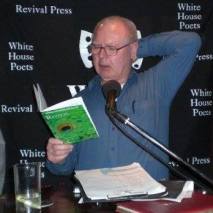 Mike Gallagher’s powerful poem, Paraic and Jack and John, tells a familiar story of the Irish diaspora, who have left to go to the UK, America and elsewhere, and the gap this left for those still living in Ireland. “not too many options there,/the bus up Gowlawám,/the train to Westland Row./Holyhead gave them choices:/Preston? Ormskirk? Cricklewood?” These men traversed the 260 mile long A5 road that runs from Holyhead on the Welsh island of Anglesey all the way to London and the Kilburn Road.
 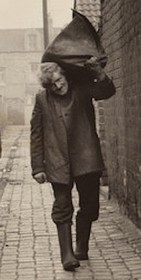 Readers of this blog are well aware of the impact Thatcher’s policies had on the coal mining industry during the 1980s. There have been a number of poems addressing the experience faced by the miners in their fight to secure the livelihoods. However, the impact was much wider than just those working at the coalface (sic). Besides the local shops gaining from a miner’s income, there were also those who delivered the coal – the coal merchants.
 Patrick Barron’s poem “The Coalmen” takes the point of view of a young child looking out their bedroom window at these black and grey men, carrying huge sacks weighing up to 50 kg, “as if they were carrying their own mothers across a river.” There is something of the mythical about these men, as though they were in disguise, as though they weren’t meant to be seen, shadows almost.
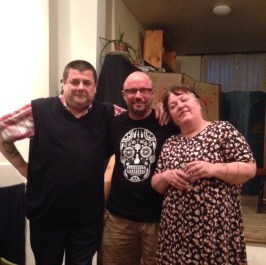 Then, I was very proud to be part of the long tradition by hosting the Sunday poetry reading at the
  “When I first heard some geezer called Martin Anus had written my life story I was chuffed. Weren’t surprised like cos I know I’m a top bloke and that. But then me mate told me it was what you would call an unauthorised biography and that he hadn’t painted a good picture of me. And I thought, how could some no mark write about my life without me knowing, or without even speaking to me? So before taking the time to find him and chop off his head off, I took to reading it. And what a load of old bollocks it is was as well. Okay, a lot of it is true, such as the beatings I dished out, and prison, and how me nephew is shagging my mum, but the rest is bullshit.”
 A reader or listener can tell if the poem lacks these ingredients, which betrays, what Fran Lock, pointedly describes as ventriloquism. And as much as I try not to provoke class war on the site, there does come a time when you get angry at such false representation, especially when you read ‘On Ventriloquism‘, such a brilliant and unrelenting poetic diatribe in response to a recent experience at an open mic. So Martin Amis, fuck off will you!
  Propaganda and censorship are the recognised tools of government; whether that government be the so called western liberal kind, or one more akin to North Korea. Of course, they use different methods in the use of these tools but essentially they serve the same purpose of maintaining power, done in the guise of protecting the values, ethos, or way of life of its citizens. Violent conflict is
  And it is children, who are the most vulnerable civilian casualty of them all. Michael Rosen highlights this tragedy chillingly in his poem Don’t Mention the Children. The poem refers to the
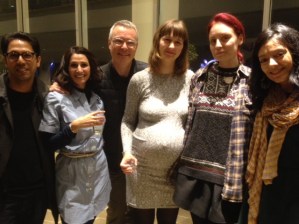 On Wednesday 6th April, Proletarian Poetry took over the Poetry Library as part of their Special Editions series. With the poets, Mona Arshi, Rishi Dastidar, Fran Lock, Clare Pollard, Richard Skinner, and Laila Sumpton, this was always going to attract a full house. For those unfortunate enough to miss the event, there is a link to a recording of all six poets readings below, and introductions from myself (I have included in the latter the time in the recording the poet started reading and a link to the original poem featured on the site). I hope you enjoy it as much as I did.
 Proletarian Poetry