 When it comes to making a decision, we all like to think that we have rational minds of our own; we are open to listening to both sides of an argument, then we put our tick or cross in the box, give our opinion in the pub, at work, or Speaker’s Corner. But the truth is, we are all a guilty of bias. However, I don’t necessarily think that’s a bad thing; for example, if Boris Johnson or Alan Sugar say something I’m pretty sure I will disagree with them; so the nihilistic part of me says, why bother listening? Most politicians with wealth (often inherited), are all eyes on maintaining their privileged lineage, thus couch their arguments in a thinly veiled rationale, which usually equates to bullshit and hypocrisy.
This applies to today’s subject, fracking. Type ‘arguments for and against fracking’ into your preferred internet search engine and you actually don’t need to read what is being said, just who is saying it, to know which side you are on. Unsurprisingly, the likes of Friends of the Earth, Greenpeace, CPRE argue strongly against fracking (causes earthquakes, polluting, won’t have huge impact on energy costs), whilst the likes of Spiked Online and those supporting oil and gas companies argue in favour (it’s not dangerous, it’s clean, will create jobs, reduce prices, etc.). Then there is Drill or Drop, which reports ‘evidence-based’ journalism about the onshore oil and gas business.
A lot of the problem with the search for new energy sources, which are sorely needed, is the governance behind their implementation. In today’s neo-liberal world, where co-operative non-profit ventures are rarely considered, big business with its anabolic influence, doesn’t need to ask for our trust, because government won’t hold them to account and are ever-seeking to offload fiscal responsibility. David Olsen’s poems,  ‘Fracking, North Dakota’ and ‘Prophet and Loss, a plague foretold’, expose the effects fracking and rabid capitalism have on the lives of people directly impacted by them. From the beginning of such processes: ‘Columns of stainless steel stab the earth./ Waste gas flares from a pipe;/ orange flames corrupt the blameless sky.’ To their catastrophic end: ‘Through every field and farm will swarm/ conforming fools consuming all,// returning naught of worth.’ The case for and against a biased attitude is a straightforward one; your opinion is either biased toward ensuring you make huge profits whatever the consequence, or it is skewed toward ensuring you have a livelihood; a job, a home, enough food, access to health services, to education. Of course, if we weren’t so biased we’d use the terms objective/subjective so that everyone would really know which side we were on.
David Olsen’s Unfolding Origami (80pp, 2015) won the Cinnamon Press Poetry Collection Award, and Past Imperfect, his second full-length poetry collection, is forthcoming from Cinnamon Press. Poetry chapbooks from US publishers include Exit Wounds (2017), Sailing to Atlantis (2013), New World Elegies (2011), and Greatest Hits (2001). David’s work appears widely in the US and Europe. A poet, playwright, and fiction writer with a BA in chemistry from University of California-Berkeley and an MA in creative writing from San Francisco State University, he was formerly an energy economist, management consultant, and performing arts critic.
Fracking
North Dakota
A young rancher leans on a fencepost,
squints at a distant horizon as if to discern
the future of his family’s land and livelihood.
Prices of open land rise with groundwater
toxicity. Soon neither man nor beast
will inhabit this home on the range.
Columns of stainless steel stab the earth.
Waste gas flares from a pipe;
orange flames corrupt the blameless sky.
Land, once infinite and timeless,
is now changed, changed utterly
by the eroding flood of dollars
created beyond the wounded horizon
by the reckless click of a mouse.
Prophet and Loss
a plague foretold
He hears the stirring underground.
Too long ignored, the sage intones
his grim portentous prophecy:
From drought shall arise a plague
devouring every fecund bud
and diligent leaf, leaving bare
sterile stems to grieve their loss.
Through every field and farm will swarm
conforming fools consuming all,
returning naught of worth. And their
new verities and misdeeds will be
unnumbered as indifferent stars.
Now the sightless sage awaits
the frenzied buzz of locust wings,
the reckless theft of common wealth.
 Is there enough anger in mainstream poetry today; in the journals/magazines and collections? In the US from
  Fran Lock, who has appeared on this site a number of times, is, along with Melissa Lee Houghton, one of those electrifying poets both on the page and the stage. Since
  The second part of the collection is a wonderful grotesque imagining of a place called Rag Town and the girls who inhabit it, in particular the ubiquitous La La. In her notes on this section Fran says: “We have the right, and we deserve the space in which to be angry. I started writing the Rag Town sequence with this one thought looping endlessly in my head.” This was driven by Fran’s disillusion with what International Women’s Day has become; originally called International Working Women’s Day, the dropping of the ‘Working’ de-classed the day, so that in Fran’s words it has become divisive to raise issues of class as they relate to women’s oppression. “It’s divisive, for example, to say that white, settled, middle-class women “escape” from unlovable and undervalued domestic labour at the expense of working-class women, immigrant women, women in poverty.”
  When I was young, my mum used to collect stamps. We had a Co-op on the corner. I remember she would come home with the shopping and blue stamps, letting me stick them in to slowly fill the pages until you had enough for a dividend (
 of pennies/ in a small leather purse and counting them when no one was looking,/ the card left face down on the kitchen table, in anticipation of a stamp.” These schemes were/are targeted at those who may not have bank accounts, or a way in which they have enough extra money at the beginning of December. This was the case for the grandmother in this poem, “I did not see the strange woman/ who woke in the dark and went digging through her pockets,/ knowing she would find nothing more than ghosts and prayers.” The schemes are now fairly widespread, the latest being
  Fluoxetine and psychiatry didn’t help; it wasn’t until he was free of daily commitments, went on mirtazapine and saw a therapist fortnightly, that he slowly came back to us. He is now just at the beginning of withdrawing from the medication as it makes him very tired and sluggish. We will see how it goes. The reason I mention this, is that this year’s theme for
  The poet, Emily Harrison, in her brilliant collection, ‘
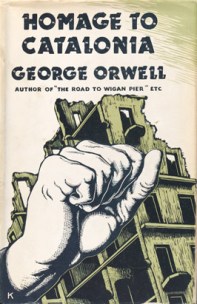 It is seventy years since George Orwell’s Homage to Catalonia was published; his personal account of the Spanish Civil War. Now, the papers’ headlines carry the same title, as the people of Catalonia once again go against the Madrid government in a so-called ‘illegal’ referendum on independence. Irrespective of one’s views about the subject of the vote, the state response of violence against all and sundry was abhorrent. Scenes across the region, but in particular Barcelona where much of the media was concentrated, and lest we forget where a terrorist atrocity was carried out along the famous Las Ramblas, showed an elderly woman with blood pouring from her head, another with a woman’s fingers being broken, and many other such beatings.
 Matt Duggan’s poem, The Spaces Left Bare, reflects on such a protest during a stay in Barcelona; one that can be seen as a wider indicator of heightened capitalism and its effect on peoples’ ability to afford housing in major cities and conurbations throughout the world; something that echoes developments from San Francisco to
  Proletarian Poetry