bloodaxe books

A Tribute to Fred Voss

The poet Fred Voss, who has died at the age of 72, was one of the great American writers of manual labour. He went beyond the poet as witness in a journalistic sense, for he lived what he wrote and he wrote more than three thousand poems.

Fred was born in Los Angeles in 1952. Initially he thought he would go into academia. On passing a Bachelor of Arts degree in English he was offered a place on a Ph.D. program at the prestigious University of California, Los Angeles. But he turned it down to begin work as a machinist, which he carried on doing for the rest of his life.

He turned to poetry as a way of documenting the lives of his fellow workers who work for the ‘man’, the ‘machine’, the ‘system’; machinists who may be making engine parts for fighter planes that drop bombs in Iraq or Afghanistan. His workmates came from across the Americas and his poetry exhibits that microcosm of working class life, which you rarely find in other peoples’ poetry, besides Martin Hayes and his portrayals of London couriers and controllers.

Fred published numerous collections. His first, Goodstone was published here in the UK by the ever astute Neil Astley’s Bloodaxe Books in 1991, in which Voss did a reading tour of the UK. His poetry had arisen out of the South Californian poetry of Charles Bukowski. But it was Professor John Osborne from Hull in the UK, who first published a hundred poems of Voss in the influential Bête Noire magazine which ran for ten years between 1985-1995. Goodstone was the touchstone of the more than three thousand poems Voss wrote over the next 35 years. Goodstone was the name Voss derived from the companies he had worked as a machinist. The poems, like the many that followed, told of the day-to-day struggles of men and women working in machine shops and factories of Southern California from the late 80s onwards.

Bloodaxe went on to publish two more collections with the wonderfully evocative titles, Carnegie Hall with Tin Walls 1998, and Hammers and Hearts of the Gods 2009, which was the Morning Star’s book of that year. Other collections include ‘Some Day there will be Machine Shops Full of Roses, in 2023 with Smokestack Books. As well as two with Culture Matters, The Earth and the Stars in the Palm of Our Hand, and Robots Have No Bones in 2018.

In the introduction to Robots Have No Bones (two years into the first Trump presidency I wrote:

“Fred Voss’s poems situate us in the workplace, and by doing so, show us the humanity and diversity of those who work there – ones who both support or hate Trump, but as one want, at a minimum to support their family, not have to struggle and work long hours to do just that.” Sadly, nothing has changed, and we are now at the beginning of another Trump presidency.

Fred was very generous with his poetry, offering me two poems in the early days of Proletarian Poetry back in 2015. Then more recently in an academic paper I wrote about his work, and that of his good friend Martin Hayes, on the Poetics of Precarious Work for the journal English (forthcoming in 2025). He was over the moon about his poetry being analysed for the precarity of the job, given his initial interest in the academic life, and it is so sad he didn’t get to see the published copy.

Two poems illustrate the lives of his fellow workers and Fred’s deep empathy and love for them. In ‘Los Angeles’ (see below), many of the workers wear crosses, believe in God, go to church on Sundays, but because of the environment in which they live, through poverty, violence, and low wages, are close to breakdown, close to ending their life. This is also seen in the poem ‘Grease Spots’, as a worker hopes the US Air Force will make a ‘grease spot’ of the Iraqis in response to the Twin Towers crashes. Voss wonders conversely, if their own government has made a grease spot of them, because the workers are barely able to feed their children and may never be able to retire.

I have a feeling that Fred wasn’t given deserved recognition by the mainstream poetry community in the US; there is no record of him on either the Poetry Foundation’s website nor the American Academy of Poets, and yet there is a Wikipedia page of his life.

Fred is a great loss both as a beautiful human being and a poet who exposed the daily struggle facing workers in the precarious waters of late stage capitalism. Our thoughts and love go to his dear partner Joan Jobe Smith.

Los Angeles’ by Fred Voss

In Los Angeles I have seen
men in factories with big crucifixes
on their chests
crucifixes
exchanged for guns
needles
leaps out of 10th story windows crucifixes
big
and heavy swinging on the massive hairy chests of these men crucifixes
exchanged for bottles that had these men face down on floors
or in alleys bottles
or needles that took their women their families
their souls I have seen men
in factories
without one trace of shame wearing big shiny crucifixes
on their chests men
this close
to picking up a knife
and ruining their lives this close
to blood they could never wash off their hands men
from gangs from prisons
from tiny rooms where the devil pulled up a chair
next to them men
who’ve earned
their crucifixes.[i]


[i] Fred Voss, Hammers and Hearts of the Gods (Hexham: Bloodaxe Books, 2009), p. 37.

in t’ George by Geoff Hattersley

cedars pubThe pub I spent much of my twenties in during the 1980s, is no longer. Turned into an Indian bar and restaurant. I’m not too down about it. After all that’s where people tend to end up after the pub anyway, so why not make it the pub. Better than some overpriced hipster bar where you can drink five pound craft ales that taste like toffee or coffee, and eat food called burnt ends. It is life’s transitions which challenge us – the old with the new. Our pub was separated into three age-based parts; ‘the bar’, where the family men went after work, then the ‘smoke bar’, where us teen/twenty something dole heads, sat at one end (with a pool table), and the ‘death end’, where the coffin dodgers sat and smoked their roll ups. (more…)
China by Clare Pollard

There is some doubt as to whether Zhou Enlai (it was not Mao) ever said, “Too early to say,” when responding to the question, “What significance did the French Revolution have on the world?” True or not, I think it is not too early to say now. The year 1789 was seen as the end of the divine rule by monarchy and hardcore nepotism. However, countries began to develop in a more paradoxical way through incremental freedom of the individual, innovation and trade coupled with exploitation and war. Today is no different. Western democracies develop through free market neo-liberal economics based on a democratic model that exports both goods and services backed up by war and centralised control.

But the reason I think we are in ‘interesting times’ is that in the past twenty years, the model of communist development has also embraced free market economics; but instead of a social democrat capitalist end game, the benefits of capitalism are being used to achieve a socialist utopia. We may not be at the end of history but you have a situation in China (and Russia too), of a ‘by whatever means necessary’ model of development; yes, let’s use the market model to create wealth, but be clear this is only to finance a socialist revolution.

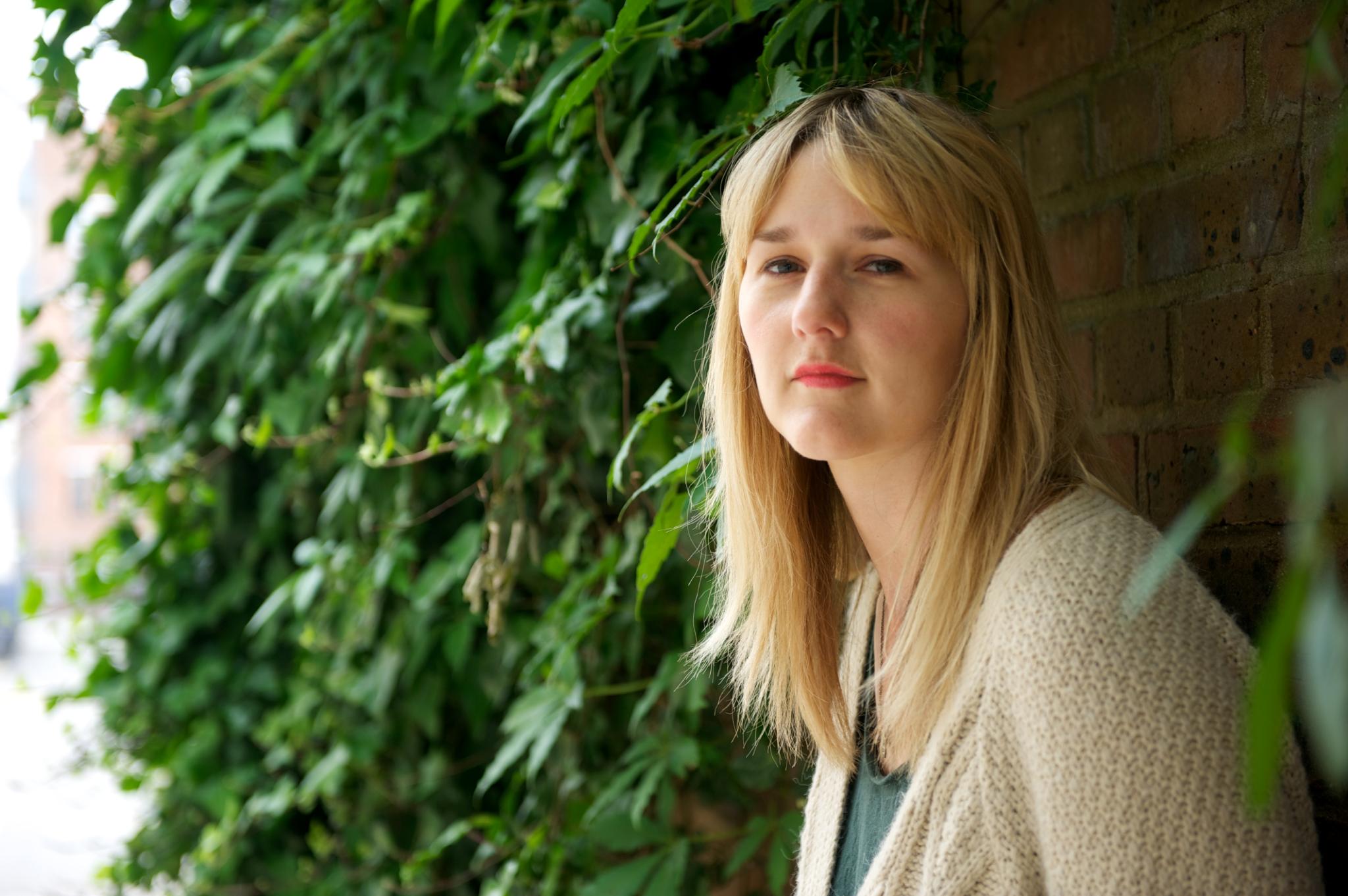
20110526_pollard_portrait__029

photo by Hayley Madden

This creates all kinds of contradictions in the country, which are perfectly summed up in Clare Pollard’s eponymous poem, China;
you have some of the most polluted cities in the world, “I saw skies so full of filth the stars were all put out,/and bags dip and fly across the flat, farmed fields/in their thousands – a plague of doves.” Whilst at the same time huge investment in green technology and growth. People now own their own businesses for private wealth and ownership at hugely different ends of the scale: “Dumplings were sold on every cluttered corner -/their dour, pinched faces sweating in bamboo stacks -/that cost 10Y or so, nothing to us.” Whilst at the same time controlling their freedom of expression and wider human rights: “We bought a watch where Mao’s arm moves when it ticks:/complicit in how time runs evil into kitsch.” Present day China is incomparable to the evils carried out to get the country to where it is today, but as Clare says in the final line: “with all this harm done/can it really come all right in the end?” (more…)