owen gallagher

‘The Harlot and the Rake, poems after William Hogarth.’ Publication Day for My Debut Pamphlet.

I’m delighted that my pamphlet, an heroic crown of sonnets after William Hogarth’s prints, is published today by Culture Matters. It comes with a wonderful introduction by Fran Lock, and cover art by the Guardian’s Martin Rowson.
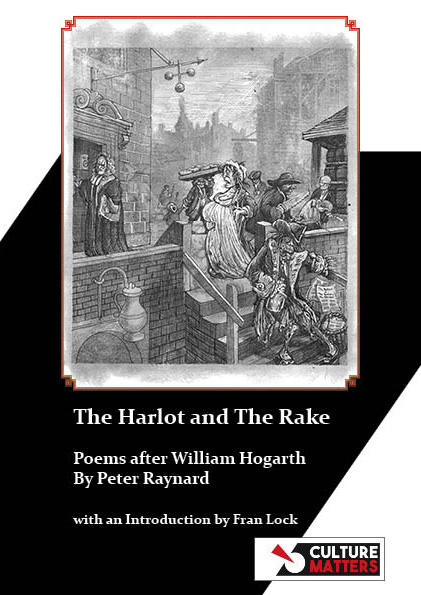
You can purchase a copy for £7.50 (plus £1.50 P&P, UK) at

https://www.paypal.com/paypalme/praynard/9 , or Worldwide https://www.paypal.com/paypalme/praynard/12

From Fran Lock’s introduction

Peter Raynard’s heroic crown of sonnets after William Hogarth’s (1697–1764) of A Harlot’s Progress (1731) and A Rake’s Progress (1733) run the same gamut of moral and social concerns but bring a contemporary socialist sensibility to bear on the interconnected fates of Tom Rakewell and Moll Hackabout. Raynard uses the connected but very different downfalls of Tom and Moll to interrogate the complexities of ‘choice’, the notion of complicity and the limits of our sympathy.
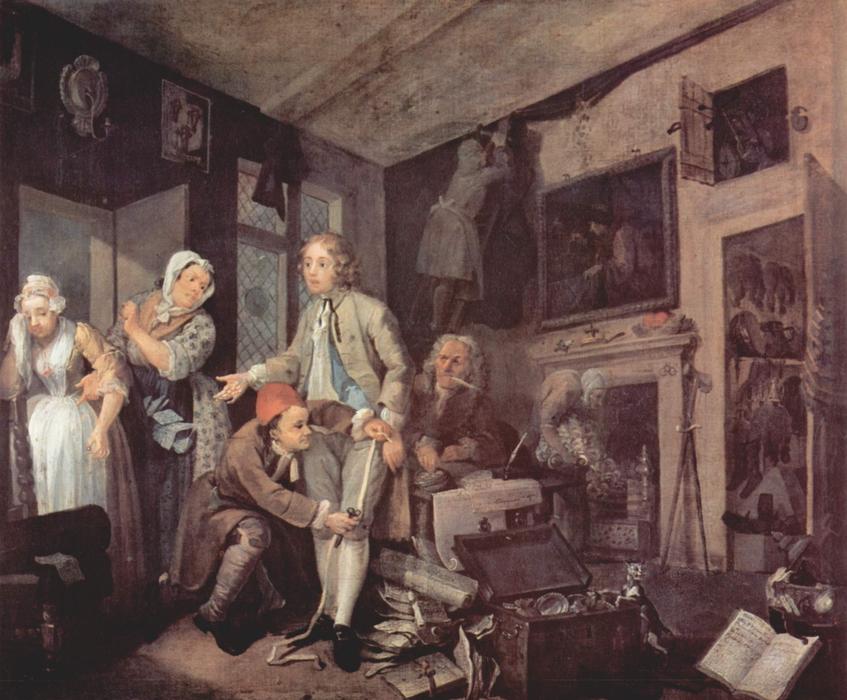
The Heir

A rich Father dies, so a son’s life as heir begins.
Vanity’s the sling which Tom will throw family
chains from: his Father, a staid suit of a man
battened down by the clamp of God’s utility

mother weeping, wife with child warming inside her.
He will leave enough to oil their grief, but says there
is no need to pray. With old money, time does shun
less miserly ways ending troughs of emotion

such wealth held: when men lay idle no-one need read
King James’ bible. New clothes fit both size and stead
with enough silver to sail a ship. London ho!
with its trade winds blown by slave labour. God well knows

the streets men of off-note graze on. All benighted
in the Capital’s treasures of sin but not be sinned

“What Hogarth etched and engraved, Raynard successfully recreates in verse.
The comparisons of life in Britain today are there to be made.”
(Owen Gallagher)

“The tone Raynard manages to hit with his quite ravishing language and the use of the 3rd
person voice as witness carries you along like you’re on some kind of walking tour of the
grubby streets of the human mind/body leaving you eager to turn the next page, the next corner, to see what has next befallen Moll or Rake.”
(Martin Hayes)

November Review – From Nana’s Luck to The Last Gang in Town?

It’s been a great second month for Proletarian Poetry (I would give you the stats but that’s a bit too geeky. I am however, warming my hands over them now).

I have got to know some great poets who have kindly agreed to have their poems featured on the site. As I’ve said before, in terms of working class lives, this is about the poems not the poets; I secretly believe that all poets have written a working class poem, they just don’t know it yet – it’s a class consciousness problem 🙂 Also as I write this, I am reminded how many of the poets I have seen read this month; all are great performers in their own right and way – you really can’t beat live poetry. For example, on Saturday I was at The Shuffle where two featured poets on PP, Inua Ellams and Karen McCarthy Woolf read alongside, Tom Chivers, Holly Corfield Carr, Gale Burns, and Harry Mann. The theme was the environment and there were a great range of poems on the subject.

This month’s poems have covered a number of themes to do with: family, gender, identity, racism, urban life, work and industry, food, and music (got to have the music). There are mothers, fathers, grandparents, butchers, assembly line workers, brass bands, activists, priests, loan sharks, and (to use the title of Inua Ellams’ poem) Lovers, Liars, Conjurers and Thieves. (more…)

The Pay Poke by Owen Gallagher

Owen Gallagher PicEvery Thursday in the bookies, men would rush in after four o’clock, look up at the board of an upcoming race and the prices of the horses, quickly scribble something on a betting slip and hand it over to me. As I looked at the bet to see if I needed to lay it off, I would hear the crackle of cellophane and the tear of an envelope. The man’s wage packet. His ‘pay poke’. Opened in front of me instead of his wife. They would often go home with an empty envelope.

Owen Gallagher takes the ‘pay poke’ and writes from the perspective of a son who has to deal with the death of his father and the payments to be made from his father’s last wage packet: to the man from the loan company and the Priest, who was paid in silver and made them ‘feel special when he gave the house/a blessing, called each of us by our name.’ Thereafter there is a change in roles where the ‘mother became the man‘ and ‘now I set aside the money‘.

This is a rights of passage poem; (more…)