Black Power, White Power, Girl Power, Soft Power, Superpower,
I’ve got the power, fight the power, power up, power down,
power to the people, power of the weak, power lists, holders of power,
gatekeepers, gatehousers, laws, wars, protest, silence, apathy, violence,
rational, ruthless, monopoly, oligopoly, oligarchy, autocracy, dictatorship,
cultural power, charisma, charm, patriarchy, matriarchy, infancy,
authority, legitimacy, language, shouting, beating, killing, Simon Cowell.
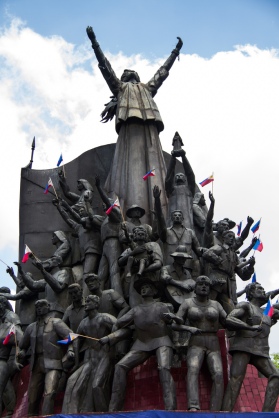 Power is ubiquitous and multi-layered. Just look at the range of power lists; from political figures, to those in the media, LGBT, there is even one for those working in ophthalmology. Power influences and affects everything we do, whether as individuals, families, groups, organisations, or countries. Your access to healthcare for example, can be determined by your ability to be an advocate for yourself, at a time when you are most vulnerable. At a state level, beyond laws, governments will use ‘softer’ powers to get us to change our habits (otherwise known as ‘nudge’); in the UK this can be something as innocuous as charging five pence for shopping bags or automatically enrolling people into workplace pensions. This then extends at a global level to international relations, where states hold power because of the ‘attractiveness’ of a number of indicators, such as political stability, health systems, wealth, or adherence to human rights. But it tells you something when countries such as the UK and US top the various soft power lists, as these cannot be extricated from their hard power of colonial and imperial interventions backed up by an arsenal of nuclear weapons. It even extends to pop impresarios such as Simon Cowell, although he presses a different kind of button to the nuclear version, thank goodness.
 As individuals, it is quite easy for us to feel powerless and Hilda Sheehan’s poem The Speaker forcefully captures this sense through the metaphor of noise. “The Speaker//is an electric vulture//….It is/a god of dropped insects/from a carriage clock/or wasp holder/left to go on-off, on-off/riddling the town’s ears/from where it came.” This barrage of messages – part of this idea of influence, of soft power – is now at a ‘volume’ we cannot control. “Inside a speaker is Hell -/a radio of church-like/persuasion/from four walls a prison/of persecutors of/television visions/crackling away in the gutters.” It is not that easy to turn things off. But this powerless feeling of not being listened to is what brings people together; we see it with Black Lives Matter, with the Occupy movement, and the Arab Spring protests. There is both a soft and hard power that individuals can exert. One that is more than just a nudge to those in power. One that is a shout so loud it cannot be ignored. (more…)
 Like Father, like son. Well, when your father is Donald Trump, those footsteps should not be ones that you follow. But when nurture combines with nature, Junior treads where he has been fomented. DT Junior,
 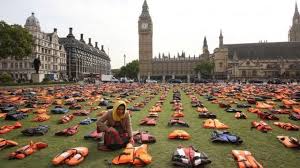 Those who came from another land, whether back in the day, or last week, are the currency of conversation and policy debate and inaction, at the present time. They are used in debates about Brexit, the war in Syria, lone terror attacks in the US, co-ordinated ones in Paris and Brussels. They are said to be the reason for Angela Merkel’s weak results in last week’s election in Germany,
  Matt Duggan’s poem “Voices from the Charcoal”, captures these fluid, turbulent and fateful times; “fishing boats once floating saviours for the persecuted/now we build walls from those we’ve liberated; /Cutting off our own ears /awakening a poisonous serpent for oil.” The powerful extract economically from other countries, through war for oil, then leave a mess that goes beyond the borders they originally set post-WW1. Matt reflects this marrying of history, “Those dusting jackboots are stomping/on the gravestones of our ancestors,/though we’d fill a whole lake with blood oil /we’d starve our own children leaving them to die on its banks.”
 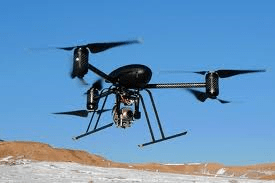 Hungry? No problem, look to the skies. Well, at the moment only if you’re a student at
  Poets have been aware of this, exposing the darker side of such developments.
 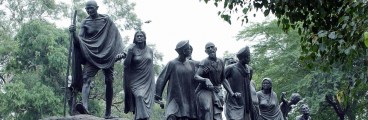 However, there are times when there needs to be protest even when the possibility of positive change has passed. A voice, or a mass of voices, coming together show the powerful in question that although they may have got away with it this time, a battle does not win a war. One of the most powerful forms of activism is marching. Marching comes in many guises outside of protest; from the obvious formation of armies going to battle, through to pipe bands. But as a form of protest the sight of hundreds of thousands of people, a great swathe of banners and heads pictured from above is a powerful image with a powerful message. Notable marches include
  The UK has a long tradition of such marches, most notably the Jarrow March in 1936, in protest at unemployment and poverty in the North East. Previous to that was the mass trespass onto Kinder Scout in the Peak District, which is portrayed by the poet Peter Riley in his ‘
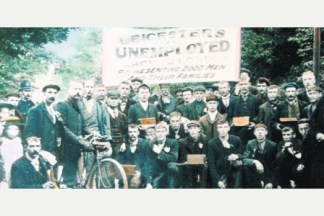 Leicester city.” But nonetheless they were successful in laying down a marker (in one case a physical one with the artwork of seven windows at Leicester’s St Mark’s Church, called
 Proletarian Poetry