Poem

Decline and Fall, and On Guillotines by Fran Lock

This is for those of us still licking our wounds in the fallout from the General Election; at the fact that Labour was seen to have lost because it was too Left wing (I know, don’t you love the media and those that lapdog them); and trying not to think too badly of those who ‘silently’ not only voted Conservative, but twisted the knife with an large overall majority.

Succour has been hard to come by. I migrated to Al Jazeera as I do when domestic news is too, well, domestic, and I felt guilty when perspective was given to me with migrant deaths in the Mediterranean Sea and Indian Ocean, and the continued war in Iraq and Syria, and the Yemen, and the secondary earthquake in Nepal.

But though certain things are relative, there has still been a need to seek solace from friends and networks. I tried to believe in the more nihilistic anarchistic view that it wouldn’t have mattered who got in, but that just made me angrier. Then there were blog posts from the poets Jo Bell, Clare Pollard, and Josephine Corcoran, who bound their anger and hurt in a constructive and humanist approach. And inevitably there have emerged poems in response, from the Stare’s Nest, Well Versed, and the new blog, New Boots and Plantocracies, which I highly recommend.

10881278_965132330180995_1124375228_nI have taken my own time to think about how to respond on the site, and I have to admit a defeatist lethargy was still getting the better of me, until I received an email from Fran Lock this morning. I met Fran after the launch of the latest issue of the Poetry Review, where she read some fantastic poems. I gave her my card (yes, got cards now for PP – getting almost corporate), and she contacted me offering some poems she has written in response to the election (poets really are the people that keep on giving). I could have chosen them all but I’m not greedy.

They made me angry, but this time in a positive way because of the language; they articulate my frustrations with Labour, my contained anger at the invisible voters, my uncontained anger at the media (I keep trying to believe we have a free press, but can only see it as free to keep feeding us its elitist bullshit). I decided on two poems, “Decline and Fall”, and “On Guillotines” because she captures all of the actors involved in the democratic farce and even manages to fit in some humour, “Ed’s head like a Pez dispenser, shot/from the neck up and wearing puzzlement/like loss of blood. Cameron, of course,/pinkly inevitable. He pokes through his suit/like a big toe.” (more…)

Andrew’s Corner by Kayo Chingonyi

I have just finished reading Selina Todd’s amazing “The People: the rise and fall of the Working Class, 1910-2010”, which wasn’t the best of reads in a run-up to what turned out to be a disastrous election result. Some of her detailed research of the first half of the 20th century, was drawn from the Mass Observation project; this was set up by a group of volunteers who wanted to create an ‘anthropology of ourselves’ and so carried out interviews with people about their daily lives. It was stopped in the 1950s then revived in the 1980s and continues today. There is also a similar project in the US called Humans of New York.

It got me thinking about how we observe people in their daily lives. One aspect, which Kayo Chingonyi’s poem Andrew’s Corner revived in me, was observations by sociologists in the US of street corner life. One of the first that I know of is William Foote Whyte’s Street Corner Society, which mapped the lives of poor Italian Americans in a Boston slum in the 1940s. Then a more famous study, Eliot Liebow’s ‘Tally’s Corner’ which has sold over a million copies. Liebow sought to show another, more positive side to the way in which African American men responded to poverty during the 1960s. It showed them not to be feckless and non-caring parents; “Leroy bathed the children, braided the girls’ hair, washed their clothes at ‘the Bendix’ (laundromat), played with them, and on their birthdays went shoplifting to get them gifts.”

 kayo chingonyi picObservation is a key quality of a poet, and Kayo does this so well in Andrew’s Corner that maps the generational experiences of a particular corner of London, “Where an old man comes, to practise/standing still, tutting that the street he fought to keep is gone.” And we are given all of the senses of change, “the world of bass,” “the smell of weed and too much CK One” and the detritus of objects that tell their own stories, “condom wrappers, kebab meat, a ballet pump”. Then finally the crossover of night to day, where “joggers dodge a dead pigeon, offer wordless/greeting to the night bus’s army of sanguine-/eyed ravers, nursing bad skin and tinnitus.” Top notch. (more…)

Hungary 1956: from a Woman in Exile by Anne Cooper

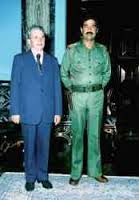
On a train at the Romanian border, two Iraqi Kurds jumped into our carriage and sat facing each other as though they had been there for the whole journey. Two Romanian border guards entered soon after. They were not interested in what four ceausescu husseinBritish men were doing visiting their country a year and a half after the fall of Ceausescu. They thought they would have fun with the Kurds; but these boys had crossed a number of borders already and were no match for the guards who had little history of dealing with foreign visitors. After what seemed like a heated exchange to us, ended in almost friendly banter, as the four of them laughed at each other’s dictators.

After a few days in Bucharest losing count of the pepper of bullet holes from the revolution, news came through that there was a coup in Moscow by hard-line communists against President Gorbachev. We sat in our rooms listening to events unfold on the World Service; the mood of local people was complete fear bordering on panic. They thought the Soviet tanks would roll in as they had done after the Second World War staying for over forty years, and that their revolution was over.

We saw the aftermath and fear that remained during those years after 1989 when we went through Bulgaria, Romania, The Czech Republic (as it still was) and Hungary. And it was in the latter country that one of the few uprisings took place against Soviet rule, and is told in Anne Cooper’s poem Hungary 1956: from a woman in exile. Here Anne explains the story behind the poem:

Shrop 015“I wrote this poem in 2006, 50 years after the uprising in Hungary that was mercilessly crushed by the Russians, a turning point for many on the left in Europe who had refused to believe news that seeped out about Stalin’s massacres of the Russian people. The spectre of tanks crossing borders and crushing a people literally and metaphorically raised the question – could this be socialism and led to the disillusionment of a generation of people who had been inspired by Russia and hoped for a better world. I wrote it following a conversation with a woman I ran into on the way back from the supermarket in Clapham. She was struggling with her bags, I offered to help. When she told me where she was from, when she arrived, I asked, “Did you come here after the uprising?” Her story tumbled out, here it is. She wishes to remain anonymous. I have written it as a poem of witness. A story of the incredible heroism shown by ordinary people in extraordinary circumstances; people fighting for democracy and the right to run their own lives, paying such a high price, yet lighting a flame of inspiration for the struggles that followed across the Eastern Bloc and beyond. (more…)

Morning Prayers by Laila Sumpton

Ibrahim lived in Idlib province in Syria. He is a graduate of English Literature from Aleppo University. But he joined the Free Syrian Army. Why? Because in 2012 the regime of President Assad burnt his library of English books during the early stages of the war; he had five hundred in all including Shakespeare and Tolstoy, as well American poetry. Beckett’s Waiting for Godot was his favourite – he saw hope in Godot. But the war as we know became complicated and many factions entered the war. Ibrahim left and is now teaching school children in Turkey.

I have followed his story via the reporting of BBC journalist Ian Pannell. I wrote a play about him called Waiting for Summer, which was shown in Brighton and have written a poem. What drew me to his story, and to Laila Sumpton’s poem ‘Morning Prayers’, is the way in which the more personal story is told. It is not the helpless uneducated victim that is often portrayed by the western media; it is someone who had hopes and aspirations like anyone living in peace.

profile picIn Morning Prayers, the hopes of a mother are set out, “You long for monotonous streets/unremarkably intact/adapting only to the seasons.” These longings for the mundane are ones that many of us take for granted, “You hope for the rush to school/to be fuelled by no more/than a stern bell ringing teacher.” Of course if you are trapped in a war, then “You pray for your son only to fear/spiders, heights and getting lost/that he will grow bored of birthdays,/only ever hold toy guns.” But we know that even the most simplest of wishes can be very difficult to fulfil. Whether it is Palestine, Yemen, Syria, Iraq, Libya, or Egypt, mothers, father, sisters and brothers hope and pray only for peace, for to read books, play, get married and live safely. Laila’s poem shows this both starkly and beautifully. (more…)

On Ellington Road by Mona Arshi

Our garden backed on to my Primary school playground. When I was six or seven, a few friends and I would lean against the school fence of a break, and shout: “MUM, biscuits!” and she would come and hand out the custard creams for us to eat on the grass, each in our own individual way. A couple of years later she went to work full-time and I would go over the road to a family of eight children before school. The breakfast production line would have made Henry Ford proud.

We lived in the middle of our street (my parents still do) and it’s book-ended by a pub and a church. And like many of the streets people grew up on, it had its array of different characters; a number of Irish Catholic families as well as those who had grown up in the city (although they were in the minority); a British heavyweight boxing champion, who’d let you knock his door and hold his Lonsdale belt. Then there was the spooky overgrown house on the corner where two brothers lived, although you only ever saw one of them – rumour was they were identical twins and never went out together, and that one had a wife who he drowned in the little pond in the garden.

mon_arshi 3Forgive these reminiscences, but I wonder how much you think back to your childhood street and all the people who lived there and where they might be now? I have to thank Mona Arshi for her wonderful poem, On Ellington Road, for jogging me back in time. But Mona has a much better memory than I do, for the detail she gives of the many characters on her street is remarkable. Old man Harvey, with his thick specs and polished shoes/shouting ‘trespassers’, yet offering us a penny for collecting/his waspy pears.” Each line or couplet has a life story that you want to explore more, “Aunty Kamel, knocking on our door, with her black plait undone,/begging us to keep her for the night.” (more…)

Birmingham to London by Coach, by Steve Pottinger

In 1925, the newly installed Chancellor of the Exchequer Winston Churchill, linked the pound the gold standard in a vain attempt to boost a dying empire. This led to an economic catastrophe and the now famous General Strike of 1926. Always one for war war as opposed to jaw jaw, Churchill advocated troops firing on strikers. So to stop him from inflicting such harm, he was assigned the editorship of the British Gazette, the government’s propaganda machine during the strike. The paper ridiculed the strikers and claimed they were a direct threat to the country’s democracy.

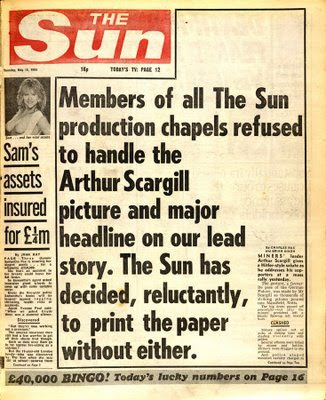
sun arthur scargillsunsplashThe media has continued with this tradition of ridiculing and demonising the working classes. During the Miner’s Strike of the 1980s, Thatcher wanted to take a very similar approach to Churchill, with a secret plot to use 4,500 troops to crush the miners and she had the backing of the right wing tabloids of the day. The Sun tried to run a front page of a straight-armed Arthur Scargill (he was mid-wave) under the heading, “Mine Furher”, but the print union (who knew if the miners lost they’d be next) refused to run it so the paper had to back down and run the alternative (see right).

However, the focus of today’s media demonization is the out-of-workers; those on benefits, who we are told have too many children, are promiscuous, criminal, and feckless. These types are paraded on the screens from Jerry Springer to Jeremy Kyle, with characters like Vicky Pollard and Frank Gallagher, and are regularly on the front pages of the tabloids. It feeds into politicians’ minds and speeches; in the UK election the focus is very much on hard working families, who can only be helped through cuts – cuts which implicitly will affect those on benefits. So if you are unemployed, disabled or unwell, elderly, you are seen as a drain on the state. All this, despite the fact that many “hard working people” are in poverty and rely on benefits and food banks. It is a classic divide and rule strategy.

steve pottingerHow does one deal with this? One obvious way is with frustration, anger, protest, and voting against those propagating a perception that disadvantaged people are the problem. The other way, which Steve Pottinger has done with great wit in his poem Birmingham to London by Coach, is to write about it in a satirical way; turn our perceptions around, make us think differently about the current demonization of a class of people, who somehow hold little power and little money, and yet seem to dictate the policy of the main political parties. I know, it’s fucking bizarre! (more…)

To a Halver by Paul Batchelor

olduvaiHere in the UK there was a radio series that explored a history of the world in a hundred objects. The objects ranged from the ancient, such as the Olduvai Handaxe made of volcanic lava that was part of a process of tool-making some 1.6 million years ago, to the relatively more modern, Victorian Mrs Beeton’s Cookbook, which had over 900 recipes and was probably one of the first cookbooks, and are so popular today (our local Waterstone’s six column shelves of cookbooks – WTF).

The poet Ted Kooser said that the mark of a good poem is one that makes you see the everyday, or the everyday object in a different way; to make his point, he references a one line poem by Joseph Hutchison, Artichoke: “O heart weighed down by so many wings.” As Kooser says, ‘Could you ever look an artichoke in the same way after reading that?’

corrugated ironIn one of the first poems featured on Proletarian Poetry, Kei Miller did just that with corrugated iron, in his poem This Zinc Roof. “This clanging of feet and boots,/Men running from Babylon whose guns/Are drawn against the small measure/Of their lives; this galvanised sheet; this/Corrugated iron. The road to hell is fenced/On each side with zinc.” I am currently writing a poem about tyres, how, when kids, we used to roll them down the hills back home for fun, or when used as a form of execution, (‘necklacing’) in South Africa and Haiti where they are put round the neck of a victim, filled with petrol then set alight.

paulbatchelorpicPaul Batchelor has taken an everyday object in a fantastic way with his poem “To a Halver”, which appears in his latest chapbook, The Love Darg; a halver is a half-brick, one half of an everyday object, that we are surrounded by, pass by, and sometimes take up as a weapon of protest or of gratuitous violence: “O half brick: your battened-down/century of faithful service in a pit village terrace/forgotten now you’ve broken loose; now you’re at large/on CCTV, flackering out of kilter till you bounce/like far-flung hail rebounding off the riot squad/or kissing the away support a fond goodbye.” Paul turns to the personal when one nearly kills his father following a Celtic/Rangers match, “when it was raining hammers and nails/after an Old Firm fixture – the decider: I exist/because you missed and broke his collarbone.” (more…)

China by Clare Pollard

There is some doubt as to whether Zhou Enlai (it was not Mao) ever said, “Too early to say,” when responding to the question, “What significance did the French Revolution have on the world?” True or not, I think it is not too early to say now. The year 1789 was seen as the end of the divine rule by monarchy and hardcore nepotism. However, countries began to develop in a more paradoxical way through incremental freedom of the individual, innovation and trade coupled with exploitation and war. Today is no different. Western democracies develop through free market neo-liberal economics based on a democratic model that exports both goods and services backed up by war and centralised control.

But the reason I think we are in ‘interesting times’ is that in the past twenty years, the model of communist development has also embraced free market economics; but instead of a social democrat capitalist end game, the benefits of capitalism are being used to achieve a socialist utopia. We may not be at the end of history but you have a situation in China (and Russia too), of a ‘by whatever means necessary’ model of development; yes, let’s use the market model to create wealth, but be clear this is only to finance a socialist revolution.

20110526_pollard_portrait__029

photo by Hayley Madden

This creates all kinds of contradictions in the country, which are perfectly summed up in Clare Pollard’s eponymous poem, China;
you have some of the most polluted cities in the world, “I saw skies so full of filth the stars were all put out,/and bags dip and fly across the flat, farmed fields/in their thousands – a plague of doves.” Whilst at the same time huge investment in green technology and growth. People now own their own businesses for private wealth and ownership at hugely different ends of the scale: “Dumplings were sold on every cluttered corner -/their dour, pinched faces sweating in bamboo stacks -/that cost 10Y or so, nothing to us.” Whilst at the same time controlling their freedom of expression and wider human rights: “We bought a watch where Mao’s arm moves when it ticks:/complicit in how time runs evil into kitsch.” Present day China is incomparable to the evils carried out to get the country to where it is today, but as Clare says in the final line: “with all this harm done/can it really come all right in the end?” (more…)

I went back to my country by Enoh Meyomesse

I could not ask the Cameroonian poet and historian, Enoh Meyomesse for permission to publish his poem “I Went Back to My Country”, because he is in jail in Cameroon. But I know he would have said yes.

Today, I saw a tweet from the African Poetry Book fund saying to read Enoh’s collection Jail Poems, which have just been translated into English and published by English PEN. You can download the book here, and donate your chosen amount (recommended is £5); all proceeds will go to English PEN’s work in supporting Enoh Meyomesse and other writers at risk around the world. They have said that the collection “has a collective commons license, and dissemination of the poems is actively encouraged.”

free-enohAs the poem shows, many refugees or those forced to leave their country for whatever reason, want to go back home, and Enoh was no different. “I went back to my country/with my soul/hosting a thousand/dreams of freedom.” So Enoh left France, despite “the warnings/of thousands //stay-here /you’re-no-longer-from-there /your tongue-has-not-tasted/the-dishes-from-there-for-years.” But the warnings were prescient and he was arrested. The poem is a plea to the Kamerun (the nationalist fighters and now rulers of the country). “When then will you cease/to crush without mercy/your most devoted children/is this the fruit of the fight for independence/that our ancestors tore from the hands of the Whites/is this the freedom that independence/carried in its gut.” He has been betrayed like the people of his country, of which he is hugely proud. “I went back to you/oh Kamerun/burning with desire/to see you tall/stronger than all.” (more…)

Nineteen Hundred and Nineteen, and Jungle by Ian Duhig

Since I began this blog six months ago, I have been amazed at how open all of the poets have been to sharing their poems and giving me background to them; and it has also been great because I have learned so much – not only about poetry but the subjects behind the poems and poets. And this experience has continued this week with Ian Duhig.

Ian Duhig (6)During a break at last week’s New to Next Generation Poets at the Institute of English Studies, where I gave a paper, I ‘collared’ Ian Duhig, who I had spotted sitting a few rows ahead of me. We chatted about a joke I had shared with him on Twitter and then I asked him if I could feature a poem or two of his on the site, which he kindly and instantly agreed to. Later that evening he gave a reading alongside Patience Agbabi and Hannah Lowe, both of whom I have featured on PP. The next morning, when I opened my emails there they were – not two but a mini-selection box of poems from Ian.

I could have chosen them all. However, I decided on Nineteen Hundred and Nineteen and Jungle because of the history behind the stories and the discrimination and attitudes towards the subjects in their situations – one a transgender Mexican revolutionary, the other a ‘successful’ homeless male sex worker. For the many of you who know Ian’s writing, the poems are founded on truth (sometimes an uncomfortable one), either historical, or from his direct experience of working with homeless people for fifteen years. And the poems are leavened with a humour as well as a directness and richness of language. (more…)