Poem

I was mad in ’85 by Adam Steiner

Back in 2006, it was reported that Tony Blair received a request from the Kazahkstani President (that notable bastion, I mean bastard of human rights) to ban Sacha Baron Cohen’s film Borat, as President Nazarbayev felt it didn’t show his country in a good light. The film wasn’t banned in the UK, but was in Kazahkstan. However, by 2012 and with Blair reaping money by advising the country on its economic development, the country’s foreign minister, thanked Borat for boosting tourism.
5132719728_c56ab8d4e8_z

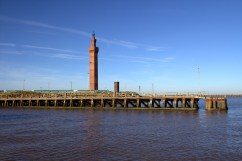
Grimsby Dock Tower*

Baron Cohen is up to his old tricks again, and this time it’s personal, well classist. In his new film Grimsby, he plays Nobby Butcher an out-of-work father of eleven children, whose brother just happens to be a Bond-like secret agent (The Brothers Grimsby – get it). As you can imagine, the Grimbarians are not happy. Although meant to be a ‘comedy’ it is once again a film made by an Oxbridge-educated that demonises the working classes by playing the feckless card. He does try to redeem himself at the end by claiming, “We are scum, but it was scum who built hospitals and fight in wars.”

For our purposes today, however, Cohen has made the mistake of dissing a town. ‘Yes, we know we live in a shit-hole but it’s our shit-hole, and no outsider needs to confirm such a state of affairs,’ is how it goes. There are a number of lists, both serious and not, that rank towns and cities; most notable I guess being the annual crap towns that once had Hull (Grimsby’s Humber neighbour), next year’s European city of culture, at the number one crap spot. But it is a more complex set of contradictions that make up the place that we live. People want different things from a town, and it is not always a hate it/love it axis on which you judge the place you live.

ASAdam Steiner’s poem “I was mad in ‘85” reflects this dilemma in the metaphor of a failing personal relationship. As Adam says, his experience was drawn from” the physical environment of Coventry over the last couple of years. It is a strange and challenging place; the combination of the encircling ring-road, old building preservation and the latest phase of reconstruction makes being here a strongly divisive experience you love to hate (like Dylan Thomas’s ‘Ugly, Lovely Town” of Swansea’ “… an ugly, lovely town … crawling, sprawling … by the side of a long and splendid curving shore. This sea-town was my world.”) At once the rising scaffolds and ring-road subways seem insurmountable barriers to change but also jilted ramparts from which to try and make a positive stand about the place and its future – I enjoy that sense of thwarted romance.” (more…)


Telemachy by R.A. Villanueva

It is sometimes only when we look back, that we see how strange a situation we were once in. In the mid-to-late 90s, within a few months, I was giving a talk and seminar at the World Bank in Washington then on the other side of the world, running a workshop on a beach with local fishermen in Cebu Province in the Philippines.

The common thread was social development; the Bank were interested in new ways to measure the effectiveness of aid interventions, whilst in the Philippines, working with the organisation the Philippine Partnership for the Development of Human Resources in Rural Areas (PhilDHRRA), we were trying to strengthen local organisations entry into a global market created by the Washington consensus, the negative impact of which was being felt by small scale farmers and fishermen. I’m still not sure if either of these ‘interventions’ was the right thing. However, the experience of working in the Philippines for a short time, has never left me. The privilege of working with and befriending local people is probably the only way a foreign person is able to really see a country.

RAVillanueva (photo by Rachel Eliza Griffiths)

Photo by Rachel Eliza Griffiths

I am reminded of this experience when reading RA Villanueva’s brilliant collection, Reliquaria that has a number of poems from his heritage in the Philippines. But the thoughts are not solely because of my personal experience, but more widely of the influence of the ‘foreign’ on traditional ways, in this case Catholicism, Spanish and American influence in the country. In Ron’s poem, Telemachy, (more…)

Abandoned Airfield at Dunkeswell by Rachel McCarthy

Metal figures prominently in the lives of the working classes. The term, the common ‘five-eighters’, although sometimes defined as being the average suit size of a soldier in the second world war, and of the working week (8 hours a day, five days a week), it is also derived from the rivet size of the workers on the shipyards. Riveting was a big job; the Titanic was held together (for a short time at least) by over 3 million rivets. Nowadays, it is the welders who have taken over from these original five-eighters.

RMcCMetal has a long history, dating back to 6,000 BC with the use of gold fashioned into jewellery. Many of the main metals of today, copper, lead, iron and tin, date back to these pre-historic times. One of the more recent metals and the subject of Rachel McCarthy’s touching poem, Abandoned Airfield at Dunkeswell, about her father’s job fitting aircrafts, is Titanium; as strong as steel it is less dense, resistant to corrosion and perfect therefore for the construction of aeroplanes. Rachel takes us right into the huge workplace, (more…)
Hall of Mirrors, 1964 by John Burnside

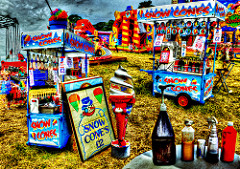
One of the stupidest things I have done (sorry Mum), which was brilliant, was walking through Coventry’s fairground at night, about one hour after dropping the freshly picked ‘magic’ mushrooms from the ‘Common’ land next to it. For those of you who have partaken in both activities separately, I hope you can imagine the heightened synesthetic experience that engulfed me.

20732439789_97b7679fa5_m

Image by Sam Leighton*

I never liked the fair (maybe that’s why I did the mushies); I was too scared to go on the major rides, a poor shot with my gammy eye for the different shies, and the music was invariably shit. The main thing I found interesting were the people who worked the stalls and rides. This was before I had any knowledge of their history and what now has become a somewhat jaundiced and discriminatory view of their ‘ways’ (sic).  They were outsiders that owned this island of fun which lit the sky for a week and echoed across the city; one lad stood out, covered in Man United patches, with straggle grease hair, he spun the waltzers with the girls in, or deftly stepped between the dodgems cars to keep the traffic flowing. All of course in the days when health and safety were the antithesis of the fun and therefore ignored.

JOhnBurnsideFairgrounds have been part of the ‘bread and circuses’ of poor and working class amusement since medieval times. I think for everyone they evoke personal memories of their childhood and a shifting sense of history. This is certainly the case in John Burnside’s darkly evocative poem Hall of Mirrors, 1964, where “the perfumes that passed for summer/in towns like ours/touched, now, with the smell of candy floss/and diesel.” But this is not ‘a fairground so much’ and the colour that one associates with a fair is outshone by his mother who is wearing, (more…)
Version by Tim Wells

In 1980 I organised a short-lived reggae night on a Monday in a pub back home. We had the usual agreement with the gaffer; it was free to get in, free to have the space, and he would make money at the bar on what is typically a dead night. It was a success in terms of the number of punters (an assortment of rastas and retired punks). But everyone was skint, and those that weren’t just bought Lucozade. We lasted three Mondays. That was my single attempt to marry my new musical love, reggae, with the punk which by now had dissipated. It was a year before the riots and the scar of Thatcher’s claw.

Punk was linked to reggae at an early stage, for the two movements had much in common. After I had seen the line of punk bands that played in our town; Clash, Pistols, Buzzcocks, Banshees, etc., reggae artists started to appear. But it was still very divided. There were few white people at the gigs for the likes of Gregory Isaacs, Burning Spear, Culture, or Prince Far I’; this was what I call the high tide of reggae, which I got into via the likes of Don Letts, Adrian Sherwood and a Mike Dread. And of course there were a number of good UK reggae bands such as Misty in Roots, Matumbi and Steel Pulse.

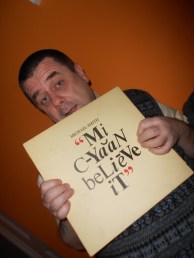
micyaanbelieveitSomeone who has much deeper roots in this history and whose site, Stand Up and Spit, chronicles many great moments of these times of punk and reggae, is Tim Wells. In his poem ‘Version’, he describes the time he first heard the great ‘dub poet’ Michael Smith, “That hard yard voice rumbled from the deck;/so unlike ours, but it spoke to us all the same.” The conditions of unemployment, poverty, and discrimination were described in a common situation experienced in the cities of the UK & US during the late 70s and 80s. “We were shook awake: no jobs, no money, no future./Hackney, Detroit, Johannesburg or Kingston JA.” (more…)

Blooding the Enemy by Marilyn Longstaff

There is much, probably too much, written about class and who the working class are. But class remains important; as the great academic Richard Hoggart said back in the late ‘50s’, “Class distinctions do not die; they merely learn new ways of expressing themselves…We shiftily declare we have buried class; each decade the coffin stays empty.” And academics continue this work, most recently with Professor Mike Savage and team who completed a major research project ‘Social Class in the 21st Century’. They outline seven categories of class, with ‘precariat’ being defined as the ‘bottom of the pile’.

I have it easy, as for my purposes, as I see the working classes are those who lack wealth and/or power – it is a broad church; maybe not as broad as the 99% versus 1%, although that has its place (by the way, Savage et al., estimate that the super-rich now account for 6% of the population – good to know they are sharing the wealth a bit more, eh!). But I do think it stretches into areas and professions not always seen as part of the means of production. (I am certain many poets would relate to this, given their average income, and the extent to which they wield power).

One such profession I would argue is teaching. Many teachers come from the communities they work in, their starting pay is below the average wage, and does not rise a whole lot more above £40k. Yes, they are not poor by ‘precariat’ standards, but neither do they earn similar amounts to other middle class professions in finance, engineering, or health care. Then in terms of their power, or influence, they are strapped in to the national curriculum and all the measures of performance they have to meet. Yet, they know their students more than other professionals, know their needs beyond education, and are such an important part of society’s development as a whole.

Marilyn Longstaff

Image by Simon Veit-Wilson

Teaching is tough, and Marilyn Longstaff’s poem, ‘Blooding the Enemy’, highlights what teachers, have to face, where bullying may not only be between children. “The pig king has entered my classroom/late as usual./He’s been fighting again.” I really like the way Marilyn, inverts the use of the word ‘know’ in a teaching setting. “They know/it’s my first year of teaching, know/I’m no Ursula Brangwen,/know//I didn’t show who was boss/in the beginning.’ (more…)

Driftwood Detroit by Julie Hogg

Imagine a city built from nothing. A city that didn’t begin its life as a series of villages. A city, once a wasteland that now houses hundreds of thousands of people who work in the purpose-built factories, to make goods for the capitalist world in order to service a communist dream.

IF

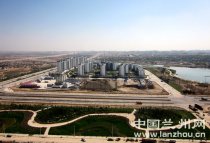
Lanzhou Xinqu is said to be China’s newest city, hewn out of the country’s northwest mountains, which by 2020 will have half a million inhabitants. These cities literally start completely empty. Such utilitarianism has given rise to the most aggressive form of industrial development in human history. One that is driven by a technological revolution backed by authoritarian rule. What will happen when a particular city’s utility ends, especially if only one product is being made? Will they simply close the city like a shop?

The lessons from western democracies, similarly driven by capitalist development, is not a good one. Local economies, founded on a single product or industry, are at the mercy of fickle and itinerant globalisation. The poster child of such a change is Detroit, the motor city. Once a thriving metropolis, now whole swathes of it are empty, with the population dropping by 25% in the first ten years of this century.

We saw something similar in the UK at a smaller scale with the mining industry, and now more recently in steel. As the base price of steel falls, the owners such as Tata in the North-east of England decide that’s it – up FullSizeRendersticks and leave. Julie Hogg’s poem, Detroit Driftwood is a Philip Levine inspired lament for Middlesbrough, where in nearby Redcar over 2,000 workers will lose their jobs. “A city is being sedated/Jesus Christ where are you now!/Listen, for God’s sake, to the almost incidental/silver-tongued debates.” (more…)

The Schoolboys by Andrew McMillan

I was once part of a team carrying out a Gender Audit of an academic institute, one involved in the field of international development. I ran a focus group with the senior male professors and got them to role play their female research fellows, for whom their career prospects were far more limited. It was one of the most hilarious and depressing experiences of my professional career. They simply couldn’t do it, and when they tried they were so lacking in empathy, it was frankly embarrassing. It was an expression of this dominant culture, one practised by those who held power in the institution and had no awareness of how it affected those who were not white, middle-aged men.

My sons look different – well, different to the majority of boys their age; they have long hair of ever-changing colours (red, bleach blonde, black), have in the past wore eye make-up, and their clothes are black. Gay, faggot, queer, are terms regularly used by passers-by at them, and sometimes those looking for trouble. The currency of such a derogatory term has increased massively in the past five years among people. It is an indicator of the way in which, what lies beneath can easily come to the fore, to the mainstream. In other contexts it is this type of behaviour that blocks pathways to opportunity for many people who look different. It engenders a fear, a dislike of ‘others’, whether they be refugees, a woman breastfeeding in public, or people with ginger hair.

Andrew Author PhotoAndrew McMillan’s poem, The Schoolboys shows the subtlety of this type of discrimination; the one that lurks and only comes out at particular times, one that is not the whim of a teenage child either, but from someone who has for many years possibly not seen such behaviour as exhibited by the subjects of the poem. (more…)
Sorry by Amir Darwish

I used to play football for a Catholic school old boys team. At the time, I never thought much about the background of the lads playing (first generation English born Irish). We all believed in a United Ireland, sympathised with the Republican cause, but it was never really spoken about. When playing football however, I began to notice the divide amongst the different teams. Our lads would often be called a dirty Fenian, or IRA bastards by the white teams. Then there were all english-defence-league-attack-funnyPakistani teams, West Indian etc., who no doubt received racist abuse during matches. In fact, I remember the Irish manager of our team, once being cut up by a black driver on the way to a game and shouting, “You fucking black bastard, get back to your own country”, without any sense of irony. This was the 1980s, and time moves on, you would hope.

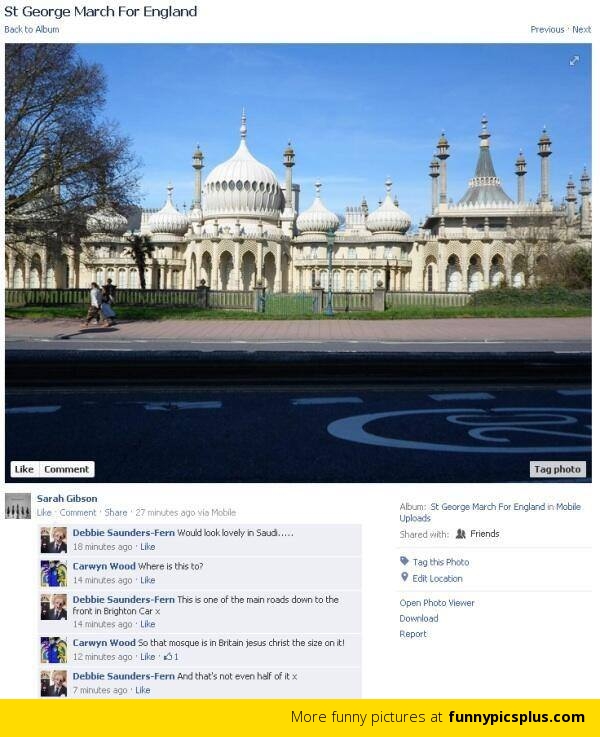
It used to be ‘No Irish, No Blacks, No Dogs’ where racism was casual in everyday use. However, we seem to live in a time where the racists think it a clever ‘political’ move, to couch their discrimination in a fight against ‘extremism’; which in today’s heated planet reads as anyone who’s a Muslim, or looks like a Muslim – I recently saw a picture of the Brighton Pavilion, where the English Defence League mistook it for a Mosque. It of course drew much bile from gullible racists. The latest incarnation of such a political strategy are Britain First, who in a documentary tried to show their ‘non-racist’ political opposition to mega-Mosques, yet when confronted by a man of sub-continent origin, shouted back at him, “Go back to the desert.”

amir darwishYou would think that all of this is beyond satire, but not for Amir Darwish, who in Sorry gives us so many things to laugh, marvel and cry about – “Abdul in the US is sorry for what so and so did;/He does not know him but he is sorry anyway”, or “If we forget to apologise for something, never mind,/We are sorry for it without even knowing it.(more…)

The Wake, and I, Agitator by Matt Duggan

Many on the Left in Scotland voted for independence from the United Kingdom in last year’s referendum; and many of those of the same persuasion in England supported that position. I didn’t, but fully understand why the Scots wanted away from Westminster control. I tend towards a more internationalist, even idealistic/impractical anarchist position – given their history, I am not a great fan of countries, especially when it comes to abstract notions such as pride, which often lead us into wars.

Nationalism tends to have two political faces united by a strong feeling of injustice. In developing countries throughout Africa and Asia, this injustice was real and came from a position of weakness and disenfranchisement. But the other nationalistic face, comes from a position of power, where they feel either under threat, or in the case of the Nazis, was deeply ideological and needed to be perpetuated throughout the world.

My fear for Scottish independence was that it would give rise to this second type of English nationalism, and the bull necked, shaven educated view that comes with it (as well as the possibility of a permanent Tory government in England). That doesn’t forego any discussion about England’s position in the world by the Left. Billy Bragg for example, has been doing this for years, and has even called for an English parliament. Poets have also been part of that conversation, as highlighted in a great review by Peter Riley, of Simon Smith’s Navy and Steve Ely’s Englaland.

20150808_152657It is most often individuals, who have influenced the history of a country; and sometimes ones who have not garnered great attention. Matt Duggan’s two poems, The Wake, concerning the almost mythological Hereward, and I, Agitator about Wat Tyler, nicely illustrate the lives of two men involved in different periods of English history. The Wake, takes the turbulent time of the 11th century during the Norman Conquest and resistance led by the likes of Hereward the Wake. “My country crippled under ember skies/land courted in blood and black bile,/the last king of England has died/a battle paced on my brethren isle.” As Matt explains, “I am drawn to characters from history that we rarely hear about these days, so, I wanted to write a longer piece about Hereward and how he became ‘The Wake’. Even today people know very little about his life, was he just a myth or was Hereward a real man bent on revenge, or maybe, just a story used to scare children?” And Matt takes a similar approach when portraying the life of the infamous Wat Tyler, who led the Peasant’s Revolt against the original Poll Tax of Richard II some three hundred years later. (more…)