working class

I was mad in ’85 by Adam Steiner

Back in 2006, it was reported that Tony Blair received a request from the Kazahkstani President (that notable bastion, I mean bastard of human rights) to ban Sacha Baron Cohen’s film Borat, as President Nazarbayev felt it didn’t show his country in a good light. The film wasn’t banned in the UK, but was in Kazahkstan. However, by 2012 and with Blair reaping money by advising the country on its economic development, the country’s foreign minister, thanked Borat for boosting tourism.

5132719728_c56ab8d4e8_z

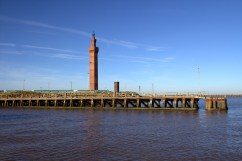
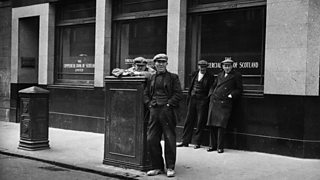
Grimsby Dock Tower*

Baron Cohen is up to his old tricks again, and this time it’s personal, well classist. In his new film Grimsby, he plays Nobby Butcher an out-of-work father of eleven children, whose brother just happens to be a Bond-like secret agent (The Brothers Grimsby – get it). As you can imagine, the Grimbarians are not happy. Although meant to be a ‘comedy’ it is once again a film made by an Oxbridge-educated that demonises the working classes by playing the feckless card. He does try to redeem himself at the end by claiming, “We are scum, but it was scum who built hospitals and fight in wars.”

For our purposes today, however, Cohen has made the mistake of dissing a town. ‘Yes, we know we live in a shit-hole but it’s our shit-hole, and no outsider needs to confirm such a state of affairs,’ is how it goes. There are a number of lists, both serious and not, that rank towns and cities; most notable I guess being the annual crap towns that once had Hull (Grimsby’s Humber neighbour), next year’s European city of culture, at the number one crap spot. But it is a more complex set of contradictions that make up the place that we live. People want different things from a town, and it is not always a hate it/love it axis on which you judge the place you live.

ASAdam Steiner’s poem “I was mad in ‘85” reflects this dilemma in the metaphor of a failing personal relationship. As Adam says, his experience was drawn from” the physical environment of Coventry over the last couple of years. It is a strange and challenging place; the combination of the encircling ring-road, old building preservation and the latest phase of reconstruction makes being here a strongly divisive experience you love to hate (like Dylan Thomas’s ‘Ugly, Lovely Town” of Swansea’ “… an ugly, lovely town … crawling, sprawling … by the side of a long and splendid curving shore. This sea-town was my world.”) At once the rising scaffolds and ring-road subways seem insurmountable barriers to change but also jilted ramparts from which to try and make a positive stand about the place and its future – I enjoy that sense of thwarted romance.” (more…)
Hall of Mirrors, 1964 by John Burnside

One of the stupidest things I have done (sorry Mum), which was brilliant, was walking through Coventry’s fairground at night, about one hour after dropping the freshly picked ‘magic’ mushrooms from the ‘Common’ land next to it. For those of you who have partaken in both activities separately, I hope you can imagine the heightened synesthetic experience that engulfed me.

20732439789_97b7679fa5_m

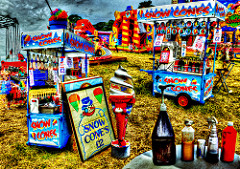
Image by Sam Leighton*

I never liked the fair (maybe that’s why I did the mushies); I was too scared to go on the major rides, a poor shot with my gammy eye for the different shies, and the music was invariably shit. The main thing I found interesting were the people who worked the stalls and rides. This was before I had any knowledge of their history and what now has become a somewhat jaundiced and discriminatory view of their ‘ways’ (sic).  They were outsiders that owned this island of fun which lit the sky for a week and echoed across the city; one lad stood out, covered in Man United patches, with straggle grease hair, he spun the waltzers with the girls in, or deftly stepped between the dodgems cars to keep the traffic flowing. All of course in the days when health and safety were the antithesis of the fun and therefore ignored.

JOhnBurnsideFairgrounds have been part of the ‘bread and circuses’ of poor and working class amusement since medieval times. I think for everyone they evoke personal memories of their childhood and a shifting sense of history. This is certainly the case in John Burnside’s darkly evocative poem Hall of Mirrors, 1964, where “the perfumes that passed for summer/in towns like ours/touched, now, with the smell of candy floss/and diesel.” But this is not ‘a fairground so much’ and the colour that one associates with a fair is outshone by his mother who is wearing, (more…)

Blooding the Enemy by Marilyn Longstaff

There is much, probably too much, written about class and who the working class are. But class remains important; as the great academic Richard Hoggart said back in the late ‘50s’, “Class distinctions do not die; they merely learn new ways of expressing themselves…We shiftily declare we have buried class; each decade the coffin stays empty.” And academics continue this work, most recently with Professor Mike Savage and team who completed a major research project ‘Social Class in the 21st Century’. They outline seven categories of class, with ‘precariat’ being defined as the ‘bottom of the pile’.

I have it easy, as for my purposes, as I see the working classes are those who lack wealth and/or power – it is a broad church; maybe not as broad as the 99% versus 1%, although that has its place (by the way, Savage et al., estimate that the super-rich now account for 6% of the population – good to know they are sharing the wealth a bit more, eh!). But I do think it stretches into areas and professions not always seen as part of the means of production. (I am certain many poets would relate to this, given their average income, and the extent to which they wield power).

One such profession I would argue is teaching. Many teachers come from the communities they work in, their starting pay is below the average wage, and does not rise a whole lot more above £40k. Yes, they are not poor by ‘precariat’ standards, but neither do they earn similar amounts to other middle class professions in finance, engineering, or health care. Then in terms of their power, or influence, they are strapped in to the national curriculum and all the measures of performance they have to meet. Yet, they know their students more than other professionals, know their needs beyond education, and are such an important part of society’s development as a whole.

Marilyn Longstaff

Image by Simon Veit-Wilson

Teaching is tough, and Marilyn Longstaff’s poem, ‘Blooding the Enemy’, highlights what teachers, have to face, where bullying may not only be between children. “The pig king has entered my classroom/late as usual./He’s been fighting again.” I really like the way Marilyn, inverts the use of the word ‘know’ in a teaching setting. “They know/it’s my first year of teaching, know/I’m no Ursula Brangwen,/know//I didn’t show who was boss/in the beginning.’ (more…)

Work by Anthony Costello

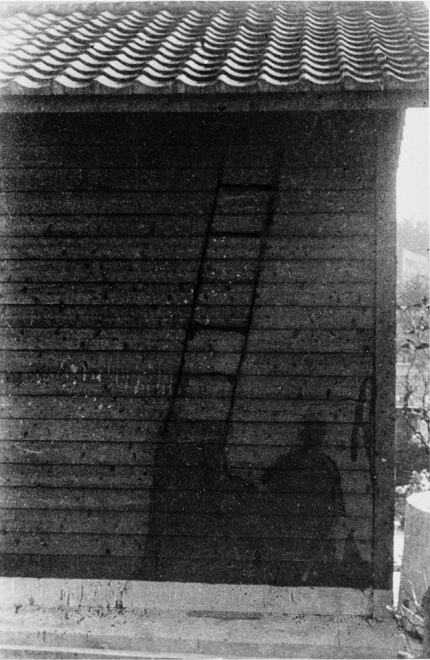
shadow of a soldierHow can you have a shadow without the subject? The picture (right) is the shadow of a Japanese guard taken by Matsumoto Eichii only a few weeks after the bombing of Nagasaki. The image is the burned-in imprint of the man with his ladder and sword at his side. We have just marked the 70th anniversary of the bombing of Hiroshima and Nagasaki in August 1945, and it is images such as these that remind us of such horrors.

The photograph of the soldier was part of an amazing exhibition, Conflict, Time, Photography at the Tate Modern in London last year. I was fortunate enough to be on a poetry course run by Pascale Petit at the gallery that used the images from the exhibition, to write poems. Many great poets have drawn on classic paintings for their poetry; Pascale herself drew on the life and work of Frida Kahlo in her TS Eliot shortlisted collection, What the Water Gave Me.

IMG_20150607_203342-2Anthony Costello has taken this approach in his poem Work, which is inspired by Ford Maddox Brown’s painting. The pre-Raphaelite Brown was fascinated by the social make up of Victorian London, with the noble ‘navvies’ (“like my labouring Irish ancestors/amongst the soil, shovels and lime”), the orphaned children and poorest (“flophouse inmates, bouncers, ragamuffin children”), and upper classes (“the gentlemen-flaneurs,/the yellow waistcoats and red bonnet Gentry”). In a single painting, a single poem, we have the Victorian system of work and hierarchy – ‘a place for everyone, and everyone in their place’. (more…)

Ignoring Alicia by Catherine Ayres

Read all about it!
Man has fifteen kids from twenty mothers!
Man achieves world record number of appearances on the Jeremy Kyle show: “My arm looks like a heroin addicts with all the DNA tests I’ve had,” he says proudly!!
Single mum pops out a kid every six months for the benefits and lives in a mansion on the hill !!!
Man asked to explain how he can you feed ten pit bulls when he can’t feed his own family!!!!

mansion for scroungersOkay, so the above are a bit surreal, but given the way in which the ‘free press’ is able to demonise people on benefits and more recently asylum seekers, I don’t think it is that far-fetched. I honestly wrote, ‘the mansion on the hill’ before I read the Sunday Express headline, “Mansions for Scroungers”; and there are plenty more of these types of ‘stories’ meant to turn working class people against each other, hence the prevalence of the term, ‘hard working family’ – no politician worth their weakness would use a term such as class anymore.

catherine ayres picThis was one of the reasons I started Proletarian Poetry and it has been reinforced when reading Catherine Ayres, sharp and angry poem ‘Ignoring Alicia’. I had no idea of Catherine’s intention with the poem when accepting it, but it stayed with me (which is usually the sign of a good poem). I talked about it with my wife, and it made her think of White Dee from the fly-on-the wall documentary Benefits Street, about a street in Birmingham where a number of people (not the whole street as the media claimed) were on benefits. (more…)

Andrew’s Corner by Kayo Chingonyi

I have just finished reading Selina Todd’s amazing “The People: the rise and fall of the Working Class, 1910-2010”, which wasn’t the best of reads in a run-up to what turned out to be a disastrous election result. Some of her detailed research of the first half of the 20th century, was drawn from the Mass Observation project; this was set up by a group of volunteers who wanted to create an ‘anthropology of ourselves’ and so carried out interviews with people about their daily lives. It was stopped in the 1950s then revived in the 1980s and continues today. There is also a similar project in the US called Humans of New York.

It got me thinking about how we observe people in their daily lives. One aspect, which Kayo Chingonyi’s poem Andrew’s Corner revived in me, was observations by sociologists in the US of street corner life. One of the first that I know of is William Foote Whyte’s Street Corner Society, which mapped the lives of poor Italian Americans in a Boston slum in the 1940s. Then a more famous study, Eliot Liebow’s ‘Tally’s Corner’ which has sold over a million copies. Liebow sought to show another, more positive side to the way in which African American men responded to poverty during the 1960s. It showed them not to be feckless and non-caring parents; “Leroy bathed the children, braided the girls’ hair, washed their clothes at ‘the Bendix’ (laundromat), played with them, and on their birthdays went shoplifting to get them gifts.”

 kayo chingonyi picObservation is a key quality of a poet, and Kayo does this so well in Andrew’s Corner that maps the generational experiences of a particular corner of London, “Where an old man comes, to practise/standing still, tutting that the street he fought to keep is gone.” And we are given all of the senses of change, “the world of bass,” “the smell of weed and too much CK One” and the detritus of objects that tell their own stories, “condom wrappers, kebab meat, a ballet pump”. Then finally the crossover of night to day, where “joggers dodge a dead pigeon, offer wordless/greeting to the night bus’s army of sanguine-/eyed ravers, nursing bad skin and tinnitus.” Top notch. (more…)

Birmingham to London by Coach, by Steve Pottinger

In 1925, the newly installed Chancellor of the Exchequer Winston Churchill, linked the pound the gold standard in a vain attempt to boost a dying empire. This led to an economic catastrophe and the now famous General Strike of 1926. Always one for war war as opposed to jaw jaw, Churchill advocated troops firing on strikers. So to stop him from inflicting such harm, he was assigned the editorship of the British Gazette, the government’s propaganda machine during the strike. The paper ridiculed the strikers and claimed they were a direct threat to the country’s democracy.

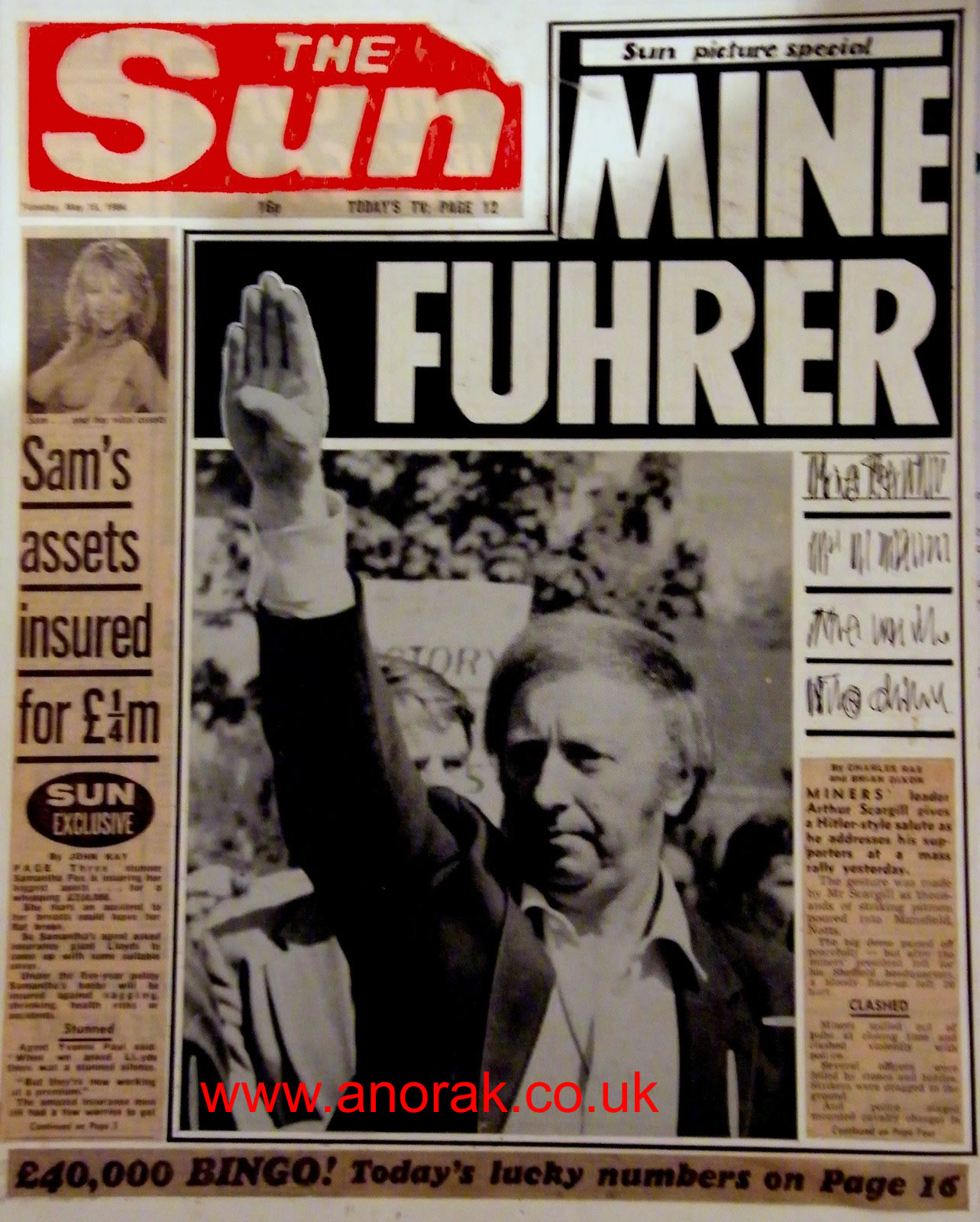
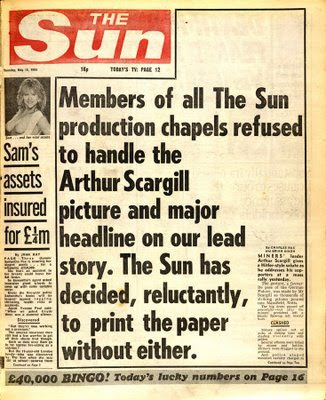
sun arthur scargillsunsplashThe media has continued with this tradition of ridiculing and demonising the working classes. During the Miner’s Strike of the 1980s, Thatcher wanted to take a very similar approach to Churchill, with a secret plot to use 4,500 troops to crush the miners and she had the backing of the right wing tabloids of the day. The Sun tried to run a front page of a straight-armed Arthur Scargill (he was mid-wave) under the heading, “Mine Furher”, but the print union (who knew if the miners lost they’d be next) refused to run it so the paper had to back down and run the alternative (see right).

However, the focus of today’s media demonization is the out-of-workers; those on benefits, who we are told have too many children, are promiscuous, criminal, and feckless. These types are paraded on the screens from Jerry Springer to Jeremy Kyle, with characters like Vicky Pollard and Frank Gallagher, and are regularly on the front pages of the tabloids. It feeds into politicians’ minds and speeches; in the UK election the focus is very much on hard working families, who can only be helped through cuts – cuts which implicitly will affect those on benefits. So if you are unemployed, disabled or unwell, elderly, you are seen as a drain on the state. All this, despite the fact that many “hard working people” are in poverty and rely on benefits and food banks. It is a classic divide and rule strategy.

steve pottingerHow does one deal with this? One obvious way is with frustration, anger, protest, and voting against those propagating a perception that disadvantaged people are the problem. The other way, which Steve Pottinger has done with great wit in his poem Birmingham to London by Coach, is to write about it in a satirical way; turn our perceptions around, make us think differently about the current demonization of a class of people, who somehow hold little power and little money, and yet seem to dictate the policy of the main political parties. I know, it’s fucking bizarre! (more…)

Nineteen Hundred and Nineteen, and Jungle by Ian Duhig

Since I began this blog six months ago, I have been amazed at how open all of the poets have been to sharing their poems and giving me background to them; and it has also been great because I have learned so much – not only about poetry but the subjects behind the poems and poets. And this experience has continued this week with Ian Duhig.

Ian Duhig (6)During a break at last week’s New to Next Generation Poets at the Institute of English Studies, where I gave a paper, I ‘collared’ Ian Duhig, who I had spotted sitting a few rows ahead of me. We chatted about a joke I had shared with him on Twitter and then I asked him if I could feature a poem or two of his on the site, which he kindly and instantly agreed to. Later that evening he gave a reading alongside Patience Agbabi and Hannah Lowe, both of whom I have featured on PP. The next morning, when I opened my emails there they were – not two but a mini-selection box of poems from Ian.

I could have chosen them all. However, I decided on Nineteen Hundred and Nineteen and Jungle because of the history behind the stories and the discrimination and attitudes towards the subjects in their situations – one a transgender Mexican revolutionary, the other a ‘successful’ homeless male sex worker. For the many of you who know Ian’s writing, the poems are founded on truth (sometimes an uncomfortable one), either historical, or from his direct experience of working with homeless people for fifteen years. And the poems are leavened with a humour as well as a directness and richness of language. (more…)

Photograph, Art Student, Female, Working Class by Liz Lochhead

liz lochheadThere are not enough portrayals of working class females in literature. What there are, often tend to be of escape from a repressive class or one of discrimination when trying to be part of another. I was therefore struck by the title of Liz Lochhead’s poem, “Photograph, Art Student, Female, Working Class“. It is both intriguing and to the point, which I think always makes for a good title for a poem.

I don’t think the poem is wholly based upon the model, Twiggy (she was 17 in 1966, not 18, was dubbed the ‘face of 66’, but didn’t go to art school), but in some ways that doesn’t matter; the young woman in question represents many from her background at the dawn of women’s liberation in the 1960s. The poem was written for Carol Ann Duffy‘s Jubilee Lines anthology. where 60 poets wrote a poem for each year of the Queen’s Diamond Jubilee; Liz’s year, whether chosen by her or not, was 1966. (more…)

My People by Kim Moore

Kim Moore PicI always try to read the poems I feature many times before knowing what I want to say about them. But for Kim Moore’s My People it took many more. When I heard Kim read it at The Shuffle in the Poetry Café I knew straight away I wanted to include it on the site but wasn’t sure how I felt about it.

Take the title – My People. The term conjures up so many mixed and opposing images; from those whose ancestors were the victims of slavery through to its use by dictators to legitimise their rule. And I think this extremity of use of the term mirrors the paradox in how Kim describes the people of My People. On the one hand they are the backbone of what politicians call ‘hard working families‘ (nee working class); ‘I come from scaffolders and plasterers and shoemakers and carers‘, low paid people who have to strike for their livelihoods. Yet on the other, they have been in prison, can dip lightly into casual racism, and ‘in the time of slavery my people would have had them if they were the type of people who could afford them, which they probably weren’t.‘ (I love the irony of that). Kim then throws us a curve ball when saying, ‘If I knew who my people were before women got the vote, they would not have cared about the vote‘, which raises issues to do with apathy towards political elites, the role of working class women, as well as whether we are ever part of a people. I think it is a problem the Left has in political terms (and I like to think I am part of their People). The Right don’t care really. (more…)