One of the things I like about doing PP, is learning from the poems – not only the universal themes that have been the mainstay of poetry, but predominantly the history, past figures critical to left wings movements, whether at the global level, or in their own country at a particular time. I tend to be more interested in figures who fought against power, than those who went on to hold it (although being in power is the harder job, as countless leaders have shown in their failure). The lives of people like James Baldwin, Rosa Luxembourg, Langston Hughes, Paul Robeson, Audre Lorde are fascinating in the paths they took to try to change the structures of power, and arguably did so in the more difficult pre-Internet, world war and revolutionary times.
Poets thus far on Proletarian Poetry have covered a number of prominent, yet sometimes not so well-known individuals who tried to hold power to account. Ian Duhig’s poem about the Mexican revolutionary Manuel Palofax who advised Zapato; Malika Booker’s lament to Walter Rodney, the Guyanese academic activist who was assassinated in a car bomb; Matt Duggan’s poem about Wat Tyler the 14th century leader of the peasants’ revolt; Catherine Graham’s poem about the writer Jack Common feted by George Orwell; John Mole’s poem of the ‘peasant poet’ John Clare; Lemn Sissay with Sparkcatchers, about the Bow Matchwomen’s strike, and Jon Tait’s Kinmont Willie, a 16th century border raider against the English. Then of course there are the poems about people, (relations, friends of poets) who led so-called ordinary lives, yet did extraordinary things when looking back from our comparative prosperity and safer lives.
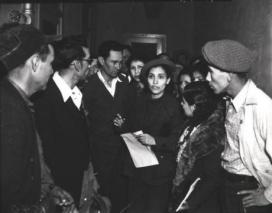
I’m very pleased therefore to add another such poem to the site, with Charles Lauder’s A Short History of San Antonio, which in fact brings the two aforementioned aspects into one; as Charles explains, ‘it started as a personal tale of my great-grandmother’s pecan tree but as poems often do, expanded into one also of Emma Tenayuca (pictured) in the Pecan Shellers Strike of January 1938, her life as a union organizer and fighter for workers’ rights (especially Mexican women).’ As Charles refers to her, she was also known as La Pasionaria (the Passion Flower), like the more well-known (in Europe at least), Isidora Dolores Ibárruri Gómez, who became General Secretary of the Communist Party after her role in the Spanish Civil War and coined the phrase, ‘no pasaran’ (they shall not pass). The juxtaposition of these  of stories two women in Mexico and Texas, is so impressive in connecting the personal with the more general sweep of history, and makes for a great read.
Charles G Lauder, Jr, was born and raised in San Antonio, Texas, and has lived in the UK for the past seventeen years. His poems have appeared internationally and he has published two pamphlets: Bleeds (2012) and Camouflaged Beasts (2017). ‘A Short History of San Antonio’ is part of a new series of political poems. He is also the Assistant Editor for The Interpreter’s House.
A Short History of San Antonio
Sixteen men in dungarees and Zapata moustaches,
the dustiness of their skin revealing
how long they’ve been in Texas,
drink coffee on the newly built
front porch, legs dangling over the edge
while the foreman’s wife hangs doors,
strolls along the garage’s tin roof
hammer in hand, looking for loose sections.
This will be her house, this tree
her personal supply of pecans.
(barefoot La Pasionaria eats ice cream
with her grandfather in Plaza del Zacate
after Sunday morning mass at St. Agnes’s,
listens to an anarchist read newspaper accounts
of revolution in Mexico, of the FBI snatching
and deporting radical leftists, of the Klan’s plan
to parade through the city; it will be a few years
before La Pasionaria organizes her first strike,
spends her first night in jail, two hundred of them
in a space meant for sixty)
Underneath this canopy, the foreman’s wife thinks,
there will be a patio of crazy paving
with places to sit and drink iced tea,
a red-and-silver two-wheeled barrel
flavoring pecans overhead with barbecued
pork shoulder and chuck roast; in October
the tree will throw down a gauntlet of pecans,
their husks like swollen wrinkled yellow eyelids
that must be peeled back, the shell heel-smashed
or delicately cracked over a tin baking tray.
(La Pasionaria discovers Thomas Paine
and Karl Marx, marches and demonstrates
for Mexican women rolling cigars, sewing clothes
in dirt-floor homes lit by kerosene lamp
with no running water or electricity; she learns
about those in white aprons and thin cotton dresses,
with their Si and ¿Baño, por favor?
herded onto long benches in airless rooms
facing a line of washed-out oil cans and piles of pecans
that must be spun into gold by day’s end)
The foreman’s wife doles out pecans piecemeal
to children and grandchildren like an advance
on an inheritance to see what they make of it,
returning at Christmas with pies and candied yams,
sugar cookies and snickerdoodles,
served after mass to East Coast cousins
with a la mode tales of stupid Mexicans
and an admonishment that ‘a pee-can
is what you keep under the bed in case of emergency.’
(twelve thousand women gather in the park
chanting La Pasionaria’s name; she organizes
pickets, hands out leaflets, ladles soup;
police and Anglos fear the West Side tide
is turning from brown to red, storm picket lines
with bricks and bats while the Klan burn effigies;
the union fears she is too much a communist
and puts a man in charge to end the strike;
the shellers get three more brown pennies
and someone to fix the scales
while men roll cracking machines
into the spaces where they used to sit)
The foreman’s wife has to tear down
and rebuild the garage for being two inches
over the property line, her hammer stained
with the squirrel that bit her son’s calf.
On the garage walls, she hangs
old license plates, tools, and a bathtub
for making gin. Sometimes, she stays up
all night playing cards. She makes
her grandchildren hold the chickens
while she wields the axe. As a widow,
she transforms the house into a duplex,
takes in tenants. Her great-grandchildren
find her on the garage roof mending leaks.
(La Pasionaria runs through an underground tunnel,
as protestors storm the auditorium, rip out seats,
smash windows, where she was just speaking;
she tries to find work, but even under an alias
she is known; she flees to the West Coast
for twenty years; when she returns, she discovers
murals of herself on the walls of laundromat, gas station,
elementary school; she teaches literacy
to Mexican children in the old barrio;
mourners bring pieces of steel to her funeral)
 Monday nights in pubs was games night. My father was in the dominoes’ team (
 Society has been set up for men; whether in their increasingly outdated role of breadwinner, although this is still the predominant form of gender relations, or in social activities – pubs, sports events and team sports. Participation rates in sport between the genders has been massively skewed. In the US for example, 40% of boys played basketball compared with 25% for girls, and that’s one of the better examples. Walk around your local park on a Saturday or Sunday morning and you will see it populated by boys and men, from six to their mid-fifties, playing football. Things are however, improving; women’s football is becoming more prominent, and other sports such as swimming and cycling are being given a certain level of equal coverage.
 Katherine Owen’s evocative poem, “Winner Stays On,” depicts a night when a woman takes on the men at pool in their habitat, similar to my own experience back in the 80s. “It’s winner stays on at The Brown Jack./ But after our game, Graham and I slip back/ to the shadows./ Not good enough to play the regulars.” On hearing this poem at the
  It is therefore nice to have a poem such as Mike Jenkins’ humorous “Alternative CCFC CV”, (his CCFC is Cardiff, not Cov) that marries the comedy of football fans with their penchant for a little bit of aggro. “I’ve stood on the North Bank, Vetch Field,/ supporting the wrong team/ (lucky we never scored!).// I’ve carried on striding/ straight into a marauding Chelsea firm/ saying ‘I’ve lived in Belfast’ to a fleeing friend.” It reminds me a little of the loveable rogue Robbo in Patience Agbabi’s poem, “
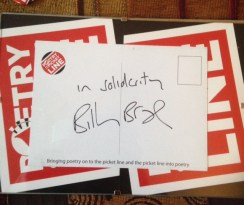 I have been heartened by a number of things in poetry recently. As previously featured,
 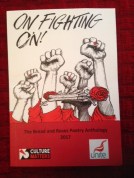 Last week, I received my contributor’s copy of
 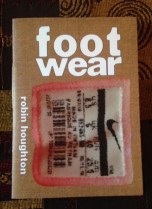 In keeping with the punk ethic of working class poetry and do-it-yourself, I got a fantastic pamphlet by the poet
 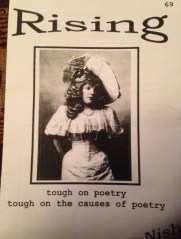 Finally, on that note, I want to give mention to
  Then, since the setting up of the Welfare State by the Atlee government, they have continually tried to dismantle it, not only from their small state ideology, but in order to spend as little on people who are most in need by lowering the taxes of the most well off So, we knew it all along, but now it’s official; the Tories kill poor and disabled people. It may not be murder, nor manslaughter, if only in the eyes of the beholder of laws they invented themselves. The new austerity age of the past seven years or more, has seen many people die as a direct result of Tory policies on welfare. In a
 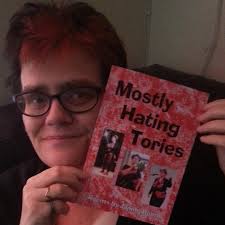 Therefore, to cheer you up, I give you the wonderful Janine Booth with her wonderful “Mostly Hating Tories”. By the way, she has a whole oeuvre of Tory hating poetry. Check them out
 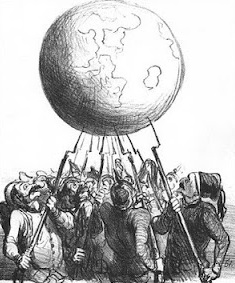 In talking with my wife the other day, we wondered which countries are doing well in the world today. Of course, ‘well’ is an abstraction and it was more easily answered in looking at those doing badly, or not so well. The world is unfurling, especially if we account for the use and impact of social media, exposing great instability. The whole European project is in question, not only in relation to Brexit, but also in terms of resolving proxy wars, as is the case in the Ukraine. Africa is on the whole improving in terms of headline indicators such as
  It is almost beyond cliché to say we have not learned the lessons of history; I say beyond, because of the hopelessness in feeling it could make any difference. But we have to; even if we feel we are repeating ourselves, because after all we are hoping not to repeat history. We see this need in poems such as Reuben Woolley’s ‘time comes counting / one two zero’, which is dedicated to the Coventry poet
  Today’s poem is by
  One of my many favourite Tom Waits’ songs is ‘
 Today’s dark poems ‘Myth Men’ and ‘Lone Man Stories’ by Sarah Sibley, are similar childhood tales of rumours, with fleeting sights and sounds of scary men. “Have you been down the cellar at The Dog?/ Seen the drayman covered in cobwebs,/ fading in and out of sight/ with the flickering light bulb;’ Such stories are drawn from the ‘outsiders’ of village life where Sarah grew up, which excited the imagination of children in an area full of country shadows. “Up at High Winds farm by the slurry pit/ we’d hide and seek in a thicket/ ripped every night by storms -/ the kind we don’t get in these parts anymore.’ And there always has to be a dark side in order for the stories to hold our curiosity. ‘For a time, stories of a lone man/ wiped us out from the copse.’ And it is always a glimpse, it can never be a clear sighting: ‘Shrimp’s sister saw him once in her rear-view mirror, disappearing down Baby Lane,/ feeling hunted again.’
  ‘Fracking, North Dakota’ and ‘Prophet and Loss, a plague foretold’, expose the effects fracking and rabid capitalism have on the lives of people directly impacted by them. From the beginning of such processes: ‘Columns of stainless steel stab the earth./ Waste gas flares from a pipe;/ orange flames corrupt the blameless sky.’ To their catastrophic end: ‘Through every field and farm will swarm/ conforming fools consuming all,// returning naught of worth.’ The case for and against a biased attitude is a straightforward one; your opinion is either biased toward ensuring you make huge profits whatever the consequence, or it is skewed toward ensuring you have a livelihood; a job, a home, enough food, access to health services, to education. Of course, if we weren’t so biased we’d use the terms objective/subjective so that everyone would really know which side we were on.
 Is there enough anger in mainstream poetry today; in the journals/magazines and collections? In the US from
  Fran Lock, who has appeared on this site a number of times, is, along with Melissa Lee Houghton, one of those electrifying poets both on the page and the stage. Since
 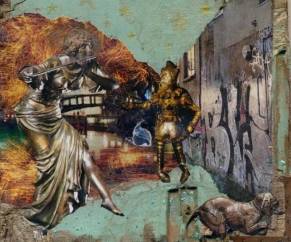 The second part of the collection is a wonderful grotesque imagining of a place called Rag Town and the girls who inhabit it, in particular the ubiquitous La La. In her notes on this section Fran says: “We have the right, and we deserve the space in which to be angry. I started writing the Rag Town sequence with this one thought looping endlessly in my head.” This was driven by Fran’s disillusion with what International Women’s Day has become; originally called International Working Women’s Day, the dropping of the ‘Working’ de-classed the day, so that in Fran’s words it has become divisive to raise issues of class as they relate to women’s oppression. “It’s divisive, for example, to say that white, settled, middle-class women “escape” from unlovable and undervalued domestic labour at the expense of working-class women, immigrant women, women in poverty.”
